
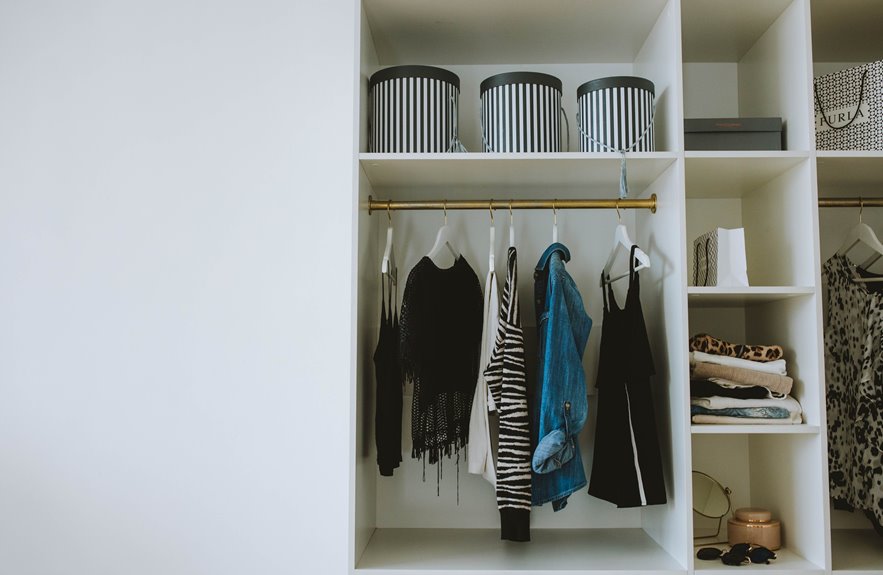
I reclaimed nearly half my closet without renovating a thing, starting with skinny velvet hangers that stacked my clothes tighter than bulky plastic ever could.
I zoned everything by how often I touch it; daily stuff at eye level, seasonal pieces banished to under-bed drawers and the guest closet.
Vertical space became essential: shoe organizers over the door, slim hanging shelves for bags and belts, shelf dividers keeping sweater stacks from avalanching.
Motion-sensor lights now wake up the shadowy corners, and I finally see everything I own.
The trick isn’t buying more space. It’s seeing the space you already have differently.
Zone Your Closet by Frequency of Use
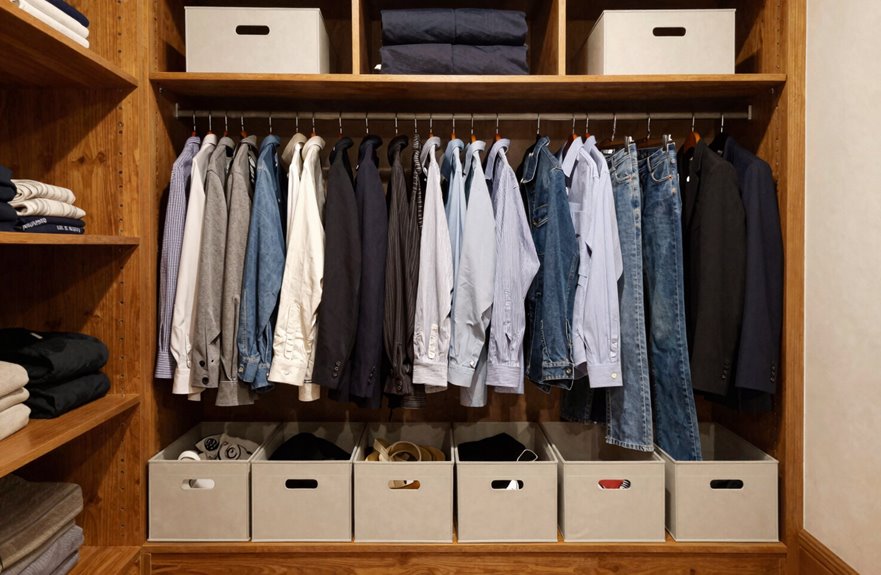
I always start my closet resets the same way: I stand in the doorway and ask myself what I actually reach for before coffee kicks in. That’s my frequency of use reality check.
I stand in the doorway and ask myself what I actually reach for before coffee kicks in.
My daily essentials, work outfits, everyday tees, and the jeans I’ll wear three times this week, live at eye level with accessible hanging rods. No stretching, no digging. I group high-use items together: short-hanging pieces, my everyday bag, that one belt I actually wear. Everything I touch before 8 a.m. shares the same wall.
Seasonal stuff and formalwear go up high, down low, or into under-bed bins. Out of sight, out of my morning routine.
I rely on visual storage with open cubbies and clear bins so I see options without thinking. Adjustable shelving and modular closet systems let me rezone when my life shifts. New job, new habits, same closet.
Switch to Slim Hangers Before Adding Storage
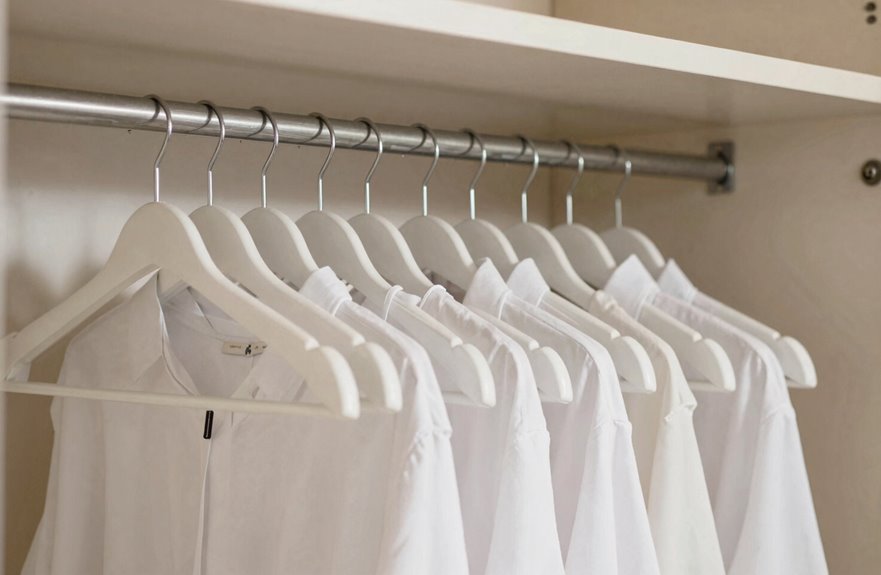
I learned the hard way that stuffing more rods or bins into a cramped closet only masks the real problem: bulky hangers eating up precious inches. Swapping to slim velvet options, like the Amazon Basics packs that run about $21 for fifty, instantly reclaimed a third of my hanging space while giving everything that satisfying boutique uniformity. If velvet feels too grabby for delicate blouses, Mawa’s steel-and-PVC versions offer the same slim profile without the fuzz, and I’ve found The Container Store’s nonslip pant hangers play nicely with either system. Even the best slim hanger won’t prevent thin trousers from creasing if you hang them incorrectly.
Space-Saving Hanger Benefits
Why do we rush to buy bins and shelves when the simplest fix is right in front of us? Swapping to slim hangers transforms closet space instantly. Those bulky plastic monsters are stealing precious hanging space we can’t afford to lose.
I switched to velvet hangers last spring, fifty Amazon Basics for about twenty-one bucks, and gained room I didn’t know I had. My clothes stopped slipping, stopped overlapping. Suddenly I could see everything.
Pair slim hangers with shelf dividers and vertical storage, and you’ve built a space-saving system that actually works. Prefer metal? Mawa’s coated rods deliver the same slim profile without the plush texture.
What matters most:
| Benefit | What It Means for You |
|---|---|
| More hanging space | Fit 30-40% more garments |
| Uniform look | Calmer, cohesive aesthetic |
| No slipping | Less refolding, less frustration |
| Affordable bulk | Complete switch under $25 |
| Foundation for organization | Pairs perfectly with shelf dividers |
Velvet Hanger Advantages
Where should we actually start when our closet feels stuffed to bursting? The answer isn’t adding bins or rods. It’s swapping to velvet hangers first.
These slim hangers deliver results. At roughly half the thickness of bulky plastic or wood, they reclaim 20–40% of your hanging space instantly. Your clothes deserve that frictionless surface, keeping silk blouses and wide-neck sweaters from sliding into a heap on your floor.
The transformation is wardrobe organization. Switching to one uniform hanger creates a calming, boutique-like cohesion you actually want to open each morning. No more clashing widths, no more mystery metal hooks snagging sleeves.
Quality doesn’t demand splurging. Those budget hangers, like Amazon Basics at about twenty bucks for fifty, let you overhaul your entire closet space without guilt. Start here, and you’ll finally breathe in your closet.
Non-Velvet Alternatives
Velvet hangers aren’t the only game in town, and they aren’t always the right fit for everyone. Non-velvet hangers like Mawa’s slim hangers deliver the same hanger bulk reduction without that fuzzy coating. They’re crafted from durable materials, such as steel with PVC coating, so they last while keeping clothing visibility crisp and clean.
Switching first lets you reclaim vertical space before buying anything else. You’ll spot gaps for space-saving organizers later, such as shelves or hooks. Options stack up as follows for closet space optimization:
| Feature | Velvet Hangers | Non-Velvet Slim Hangers |
|---|---|---|
| Profile | Ultra-slim | Equally slim |
| Texture | Flocked grip | Smooth, coated grip |
| Durability | Good | Excellent |
| Best for | Delicates | Everyday, heavy items |
| Next step | Add storage immediately | Assess, then organize |
See what you’ve gained. Then decide if you need more.
Claim Vertical Space With Hanging Organizers
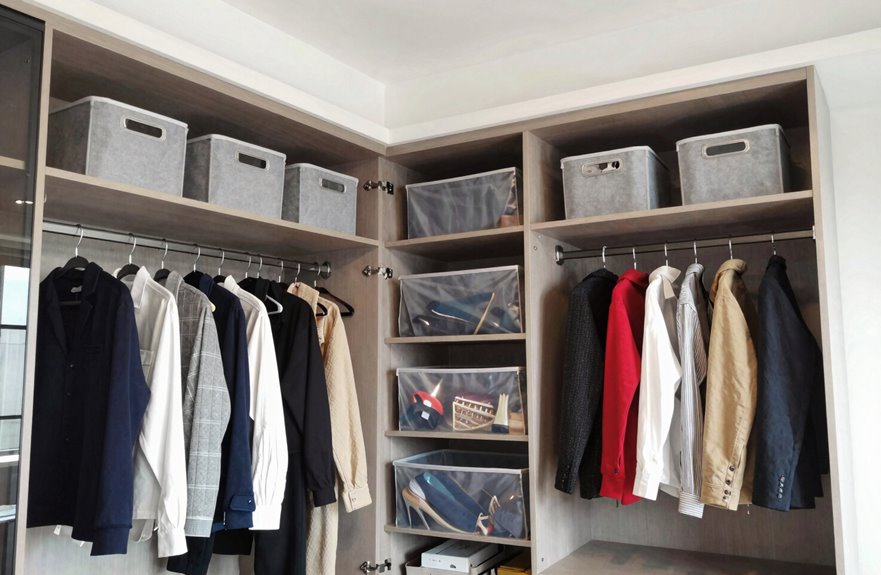
I’ve found that three simple hanging organizers can transform what used to be my closet floor, littered with scarves, belts, and that one rogue purse, into actual breathing room. For closet space optimization, I hang a hanging organizer from my closet frame to create instant shelf space without expanding my footprint. I hang belts, scarves, and purses vertically, always checking weight limits first. The Container Store 6-Compartment Hanging Wide Closet Organizer offers breathable poly-cotton and multiple compartments for accessories hanging. For shoes, I stack Seville Classics 3-Tier Resin Slatted Shoe Racks, utilizing vertical storage with wide, expandable slats. My over-the-door organizer works overtime as well. The Target 26-Shelf Mesh Shoe Organizer and Yamazaki Over-the-Door Hanger pack slim compartments full of smaller items, making efficient use of vertical space.
Convert Your Door Into Accessory Storage
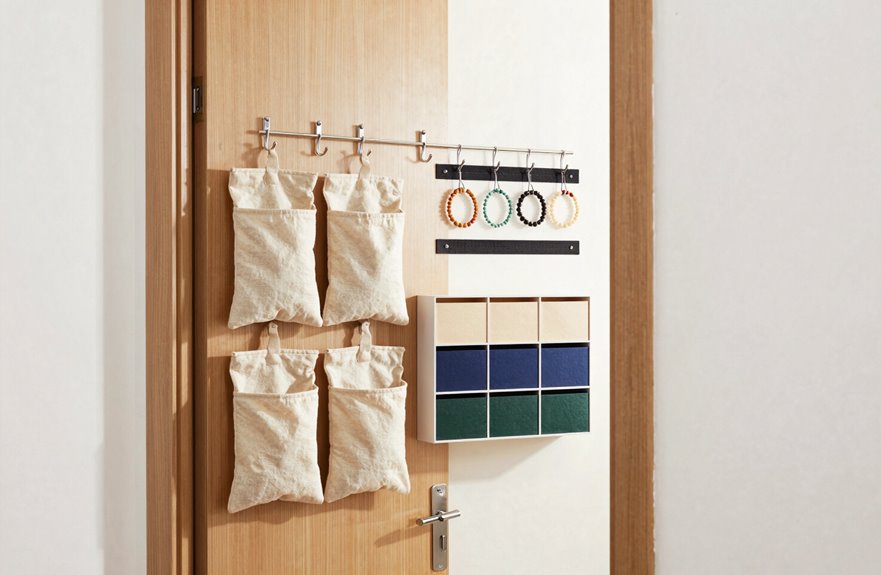
I’ve found that the back of a closet door is basically wasted real estate until you stick an organizer on it. Suddenly you’ve got twenty-six mesh pockets for shoes, or a slim row of hooks for scarves and belts, reclaiming inches you never knew you had. Low-profile hook systems work well because they hug the door without rattling every time you close it, which keeps your storage solution quiet and functional. Whether you choose a shoe rack, a row of sturdy hooks, or even a shallow cabinet that swings open on hidden hinges, you’re converting dead space into a practical, grab-and-go system for the accessories you reach for daily.
Over-the-Door Organizers
Where else can you find twelve square feet of prime real estate you’ve completely ignored? Your closet door. Over-the-door organizers transform dead space into functional storage solutions without drilling a single hole.
What transformed my closet space:
- A shoe organizer with 26 mesh cubbies, perfect for sneakers and flats up to women’s size 11
- Slim hanging organizers that barely extend past your door edge
- Door-hanging towel racks with bars plus deep hooks for belts and jewelry
- Minimalist steel designs in white or black with hanging hooks for small items
- Clear pockets that let you see everything at a glance
For true space optimization, mix slim hanging organizers with specialized hanging hooks. These door-hanging systems keep accessories visible, accessible, and off your precious closet floor.
Hook Systems
Over-the-door organizers give you pockets and cubbies, but sometimes you need something simpler: a hook. I’m talking about the kind of space-saving, door-mounted solution that transforms your forgotten door into prime real estate for accessories.
Not every closet organization problem needs complex answers. Take the Yamazaki Home Over-the-Door Hanger. Five sleek hooks, under two inches deep, holding scarves, belts, hats without eating floor space. Hooks provide instant access with minimal installation requirements.
Pair these with mesh shelves elsewhere, and you’ve got modular storage that functions effectively. Hang tomorrow’s bag, today’s jacket, yesterday’s scarf, all visible and reachable. Adjustable options let you customize height for your items.
Your door can serve as functional storage space.
Hanging Shoe Racks
How many pairs of shoes are currently falling out of your closet every morning? I’ve been there, tripping over sneakers and hunting for matching flats. Over-the-Door solutions transform wasted door surface into functional shoe storage.
What works for maximizing closet doors:
- The Target Brightroom hanging organizer gives you 26 mesh cubbies, perfect for slim shoes and sneakers up to women’s size 11
- Vertical storage reclaims your floor space
- These space-saving systems add less than 2 inches of door depth
- Color-matched hardware blends with your existing decor
- Five-hook minimalist options handle accessories beyond just footwear
I installed mine last month. My vertical storage keeps everything visible, accessible, and off the ground.
Contain Folded Items With Shelf Dividers and Bins
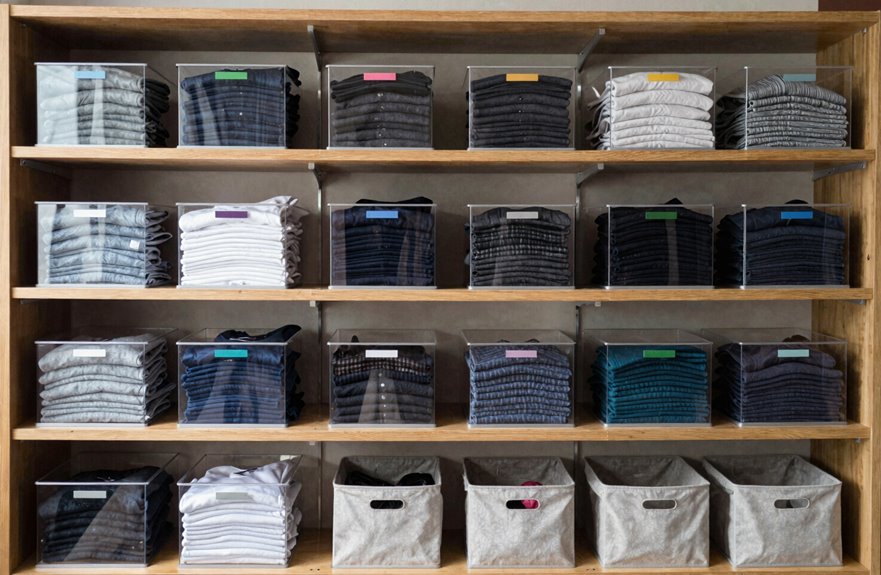
Why do folded clothes always seem to merge into one indistinguishable pile the moment I turn my back? Shelf dividers and clear bins solve this problem.
Shelf dividers changed everything for me. I use acrylic dividers, like Lynk Tall Shelf Dividers, to create neat, separate stacks that actually stay put. No more sweater avalanches. For my folded garments, clear bins are my secret weapon. The Container Store Clearline Open Bin lets me see exactly what’s inside without rummaging.
Here’s my system: stackable bins exploit vertical space, while drawer organizers handle socks and underwear. I position everything at eye level or below, so no digging is required. This closet organization approach isn’t about perfection; it’s about building a space that functions well and feels inviting.
Illuminate Shadowed Zones With Motion-Sensor Lights
Where do single socks go to die? I’ve found them crumpled in the darkest corners of my closet, hiding in shadowed zones where my eyes simply couldn’t reach. That’s why I’m obsessed with motion-sensor lighting for closet illumination. It transforms those murky depths into welcoming, usable space.
What I’ve learned about bringing light into the darkness:
- Automatic lighting activates the moment I reach inside, eliminating the need to fumble for switches
- Occupancy sensing through Caséta smart systems provides targeted, intelligent control
- Wireless options work perfectly in rentals without built-in fixtures
- Strategic sensor placement above the door prevents false triggers from hallway traffic
- Energy efficiency means I’m not wasting electricity on forgotten bulbs
This lighting integration completes my closet organization system. I can now find what I need without searching through shadows.
Relocate Off-Season Items to a Nearby Backup Space
When exactly did I realize I own thirty-seven sweaters I’ll never wear in July? That moment changed everything. I needed off-season storage that actually worked.
I started with under-bed bins. My Iris drawers slide out smooth, keeping winter wool accessible but invisible. For bulkier items, space-saving containers like vacuum bags shrink puffy coats to nothing. I created satellite storage in my guest room closet, a backup closet space that feels miles from my morning routine.
My system:
| Storage Zone | Container Type | Best For |
|---|---|---|
| Under-bed | Iris drawers, fabric bins | Folded sweaters, jeans |
| High shelves | Clear stackable bins | Accessories, shoes |
| Guest closet | Vacuum bags, garment boxes | Bulky coats, formal wear |
| Basement | Labeled totes | Extreme off-season items |
I label bins clearly, keep a simple inventory management list on my phone, and rotate wardrobe pieces twice yearly. This eliminates the need to dig through parkas to find a sundress.