
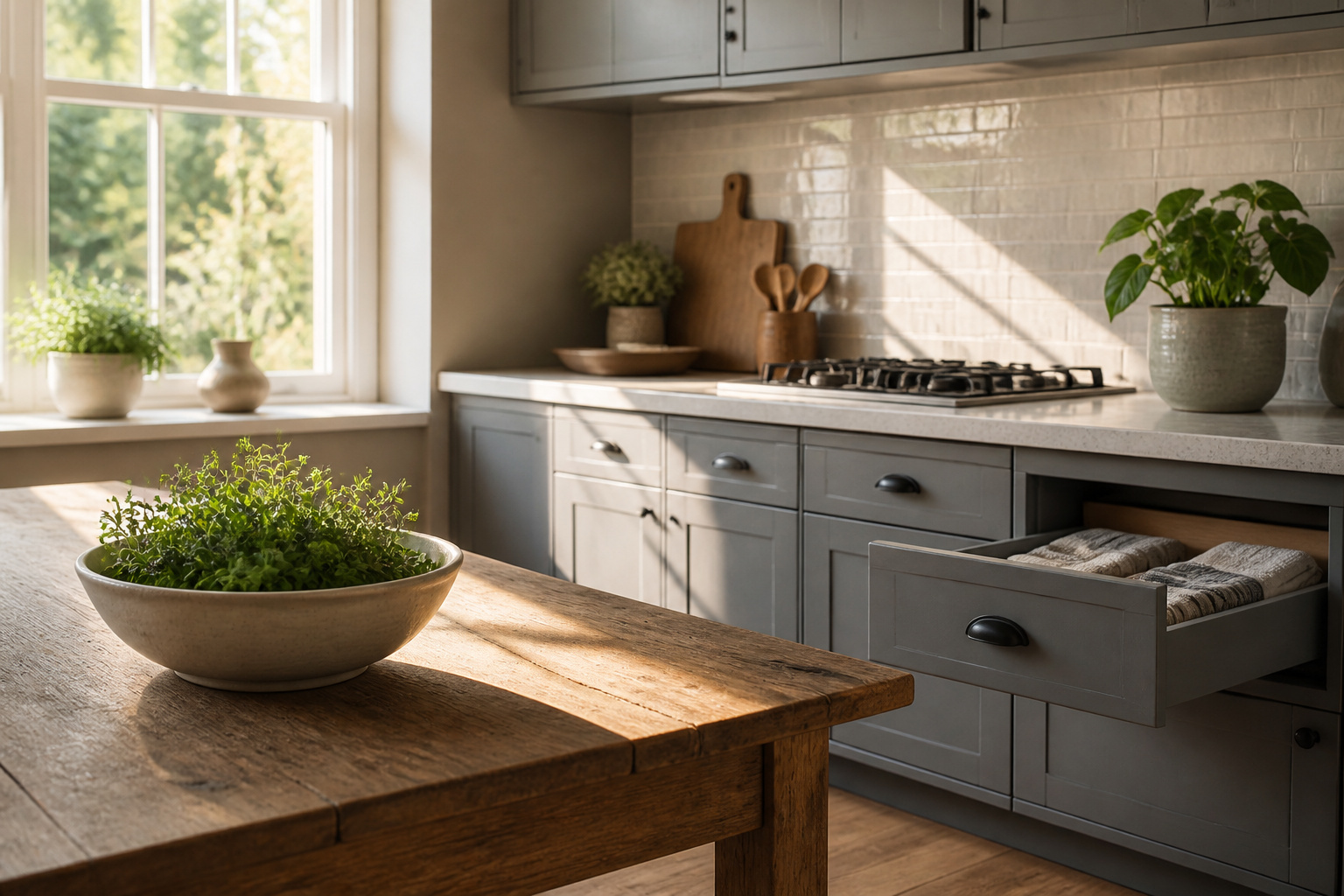
Kitchen useful ideas in 2026 range from a $25 LED strip to a full combo oven swap, and the deciding factor is how long you plan to stay in the space. A pull-out trash bin or drawer divider travels with you; a built-in charging drawer or tile floor only pays off if you own the walls. The $340 weekend redo that turned honey oak into soft gray cabinets with stick-on backsplash tiles proves which side of that line matters most.
1. Storage on Both Sides of the Kitchen Island
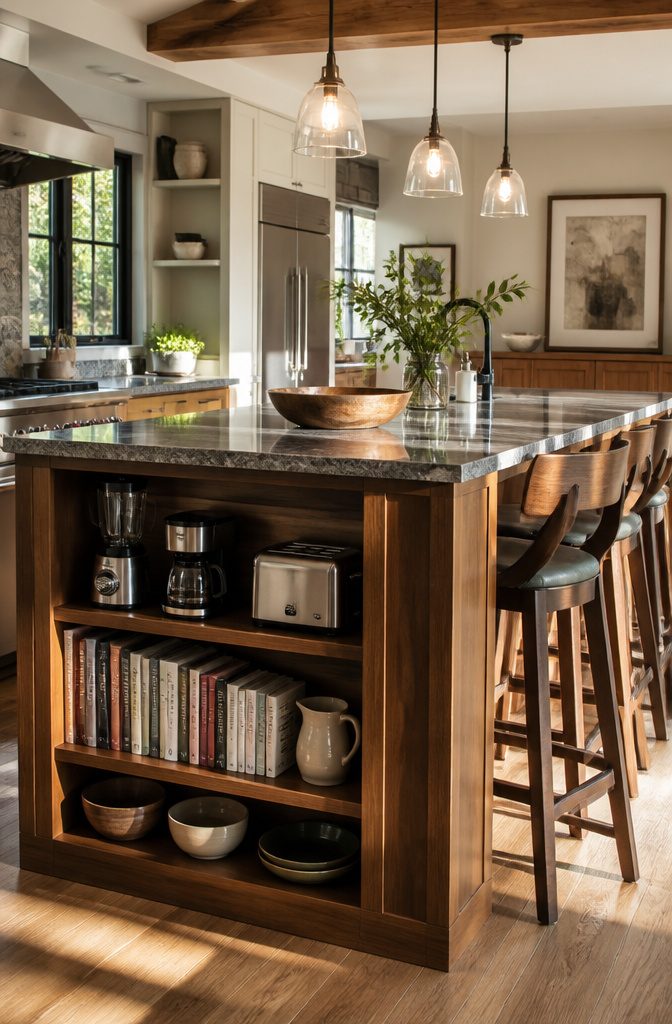
The back side of a kitchen island is usually just a panel of wood or drywall, which means 12 inches of depth or even 8 inches can be reclaimed for storage without stealing legroom from the seating side. In my own plan, I put 12-inch deep shelves on the eating side for cookbooks and small appliances, the things you reach for once a day rather than once an hour. That choice matters because anything deeper turns into a cave where items go to die, and anything you store behind stools needs to be worth the small hassle of leaning in.
This works even when the island sits against a wall on one side. The wall-facing cabinets become the better spot for pantry overflow or small appliances you do not use daily, since you are not climbing over stools to reach them. Open shelving on the back side is another route if you want to keep pretty cookware or recipe books visible, though I would only do that in a kitchen where dust is not already winning the war.
2. A Pantry Alternative
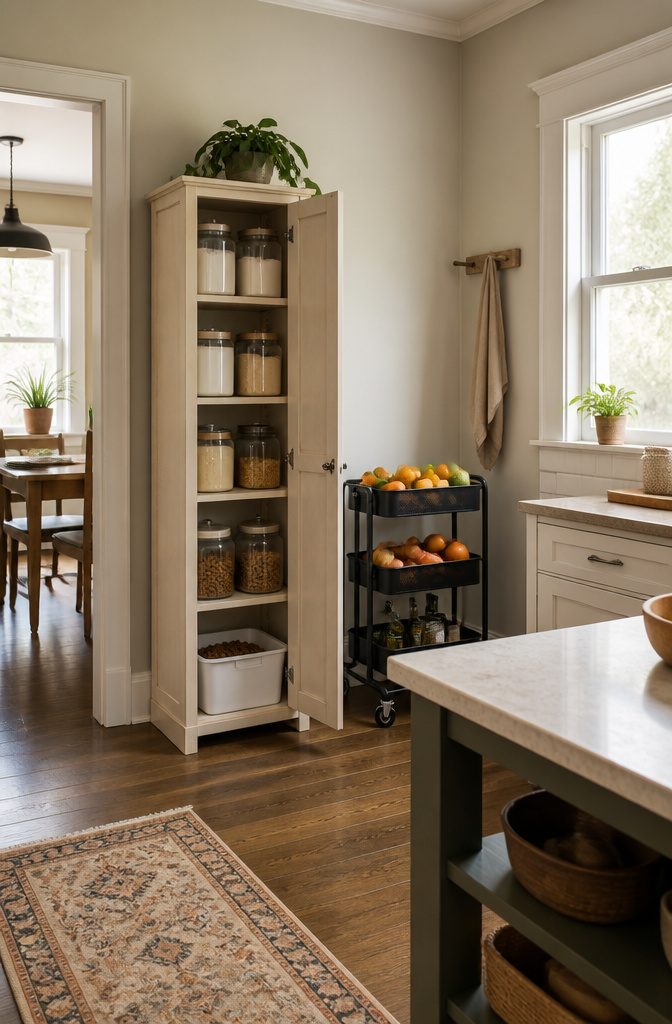
A kitchen with no built-in pantry still has three solid paths. Rolling carts keep everything mobile, which matters when you need that wall back for a table or a work surface. Freestanding cabinets give you real doors and a finished look for a few hundred dollars. Converting a nearby closet costs the least if you are willing to add shelves yourself and lose the coat storage.
In my first apartment, the kitchen was a galley with six cabinets total. I bought a 24-inch wide IKEA cabinet with a single door and three adjustable shelves inside. It stood against the blank wall beside the refrigerator and held two weeks of dry goods, the pet food, and all my baking staples with room to spare. The door was the reason it worked. Open pantry shelves look good in photographs, but flour and cereal attract pantry moths and the occasional mouse no matter how clean you keep the place. A closed cabinet stops that problem before it starts. I have used open shelving since then for dishes and glasses, but dry goods still go behind a door.
3. A Touchless or Pull-Down Faucet
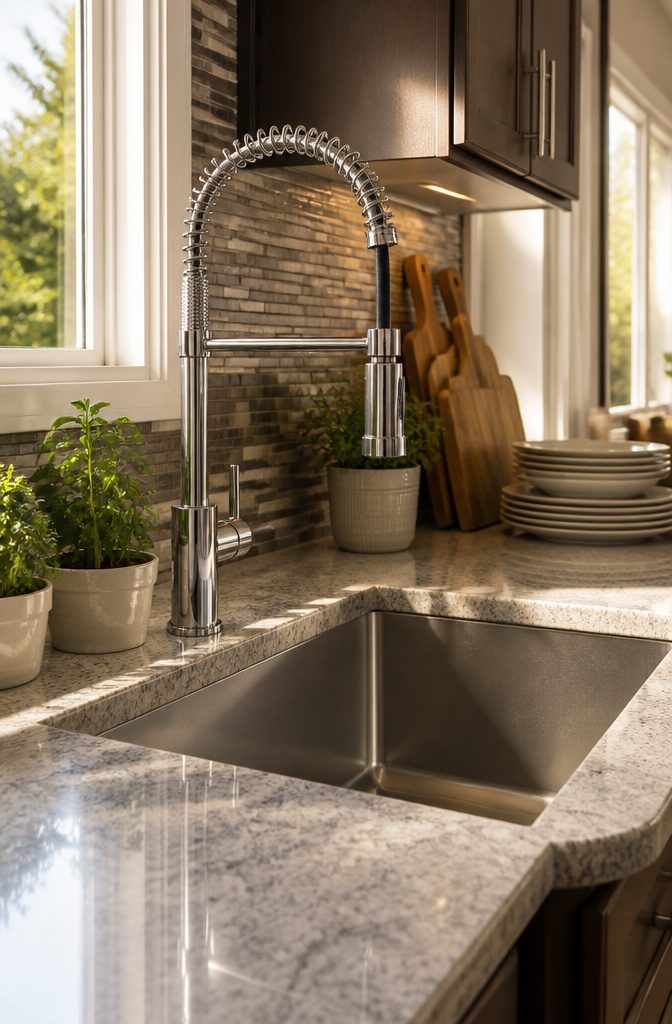
Touchless faucets look smart on paper, and they genuinely are when both hands are covered in raw chicken. The wave sensor kept me from coating the handle in bacteria every time I needed to rinse, which felt like a small kitchen victory. The problem came eighteen months later, when the sensor started firing randomly or not at all. Replacing the electronics would have cost nearly as much as a whole new fixture.
The pull-down faucet I swapped in has now run four years without a hiccup and cost $180 at a big-box store. The hose weight mechanism matters more than most people check for, a heavy counterweight on the hose underside is what pulls the spray head back smoothly and keeps it seated. Cheap models skip this or use a weak spring instead, and you end up feeding the hose back by hand every time. For a busy kitchen, a reliable pull-down beats a fancy sensor that quits mid-lease.
4. A Microwave and Oven in One
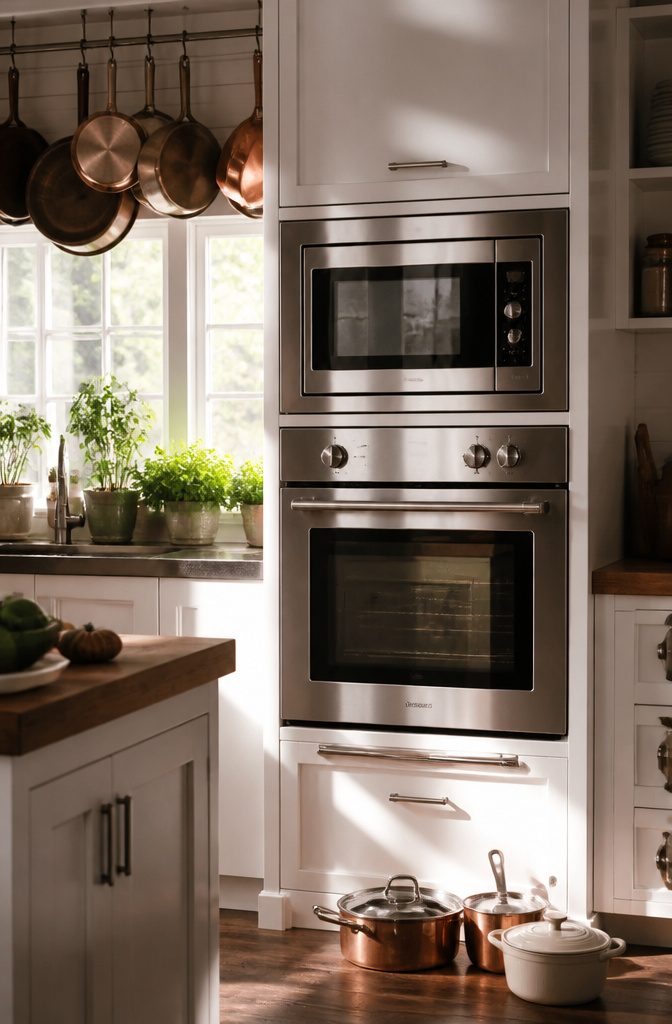
The Samsung 30-inch Electric Steam Cook, Flex Duo Wall Oven plus Microwave packs a microwave, convection oven, and split lower oven into one vertical unit. For a small kitchen, that is a lot of function in thirty inches of wall space, and the countertop stays clear.
A friend in a condo went this route. Her microwave cavity turned out smaller than a standard over-the-range unit; a casserole dish or anything wider than a dinner plate would not rotate. When the microwave magnetron failed after three years, the whole combo had to come out for service. No swapping one half, no waiting on a single part.
A combo unit fails as one piece, and the repair bill matches the footprint. For a kitchen you plan to live in five years or more, stacking a separate microwave above a standard wall oven leaves you room to swap either half when the time comes. The Samsung earns its keep in tight spaces, but only if you measure every dish you own against that cavity first.
5. Drawer Dividers and Cabinet Organizers
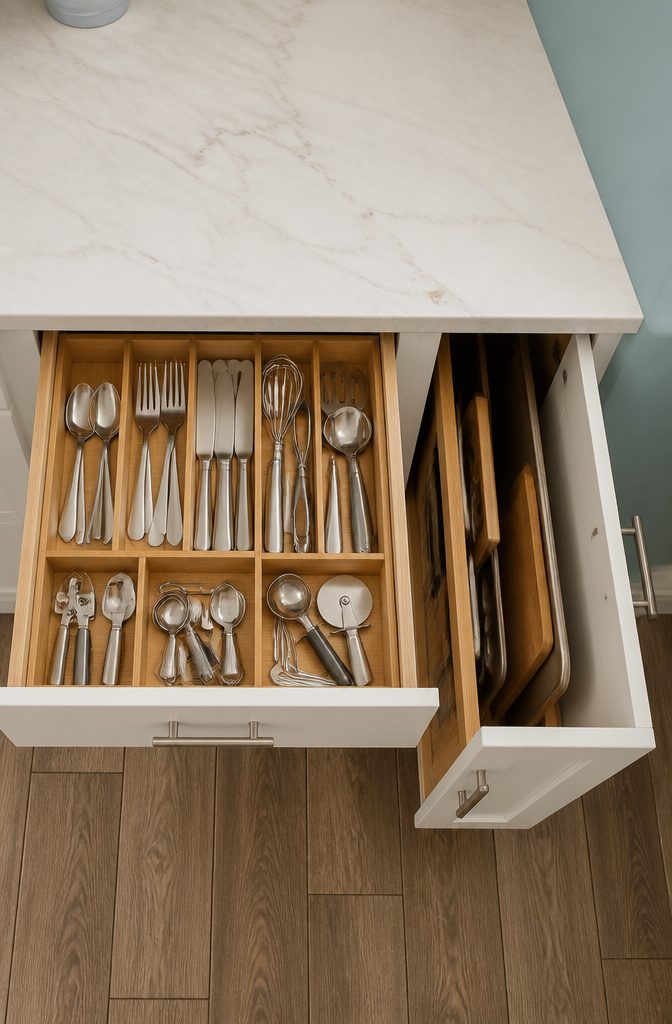
Drawer dividers and cabinet organizers sit at the foundation of any kitchen that actually functions, not somewhere down the wish list after the fun stuff. I treated them as essential from the start because a drawer that holds everything in its place saves ten minutes every time you unload dishes or pack lunch.
The bamboo dividers I cut to fit a 15-inch silverware drawer cost less than a takeout dinner and took maybe twenty minutes with a hacksaw. Cutting them myself meant no gap at the back where spoons slide underneath and vanish. For the 36-inch cabinet under the counter, a pair of tension rods turned the whole depth into vertical slots for baking sheets and cutting boards. Standing them on edge means grabbing one sheet without the rest avalanching onto your feet.
Clear containers with labels won the real victory in my household. Before, rice lived in its original bag, which meant three different people bought three new bags because nobody could see what was already there. Now anyone putting groceries away knows exactly where it goes, and the container shows when we’re running low without anyone having to open it.
6. A Pull-Out Trash Bin
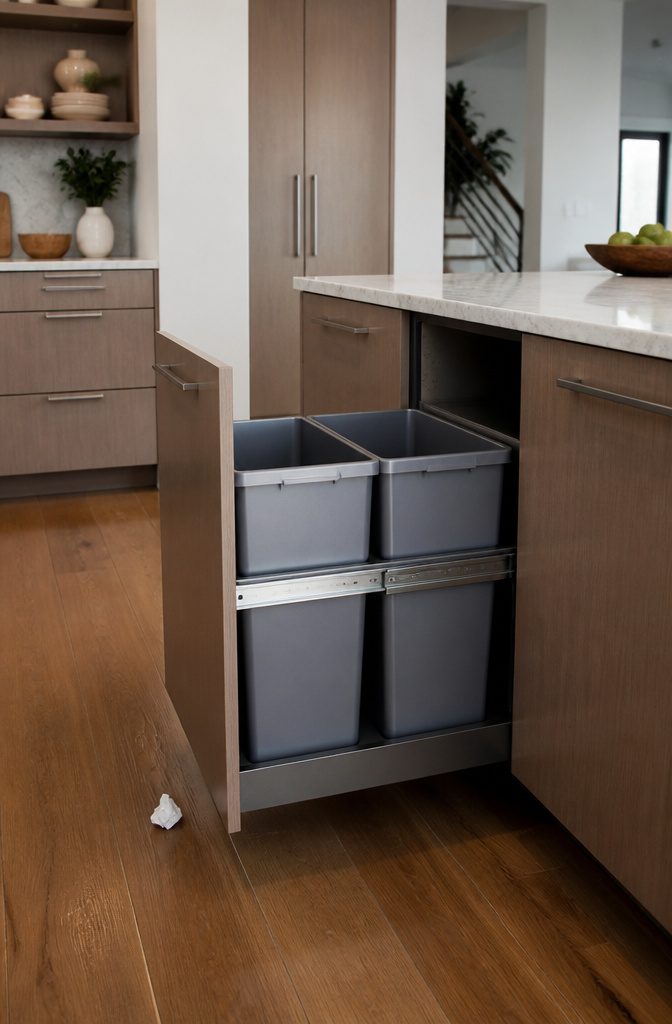
A pull-out trash bin does more for kitchen tidiness than almost anything else I have tried, because the alternative is a bag sitting where you can see it. The first one I installed was an under-sink kit from a hardware store, about $35, which attached with two drilled holes and a simple frame. It worked, but the compartment was too small for a standard 13-gallon bag; I ended up buying smaller ones that cost more per roll and still bulged at the seams.
Later, in a place I owned, I spent $80 on a cabinet-mounted slide-out with two bins side by side. That one took a 13-gallon bag easily, and the second bin held recycling without the pile of bottles that used to collect on the counter. The two-bin version is the one I would save for, even at more than double the price, if the cabinet depth allows it. For renters, the under-sink kit still beats nothing, but measure the interior height first; plumbing pipes eat more space than you expect, and a bag that catches and tears on a valve is worse than no slide-out at all.
7. A Way to Hide Small Appliances
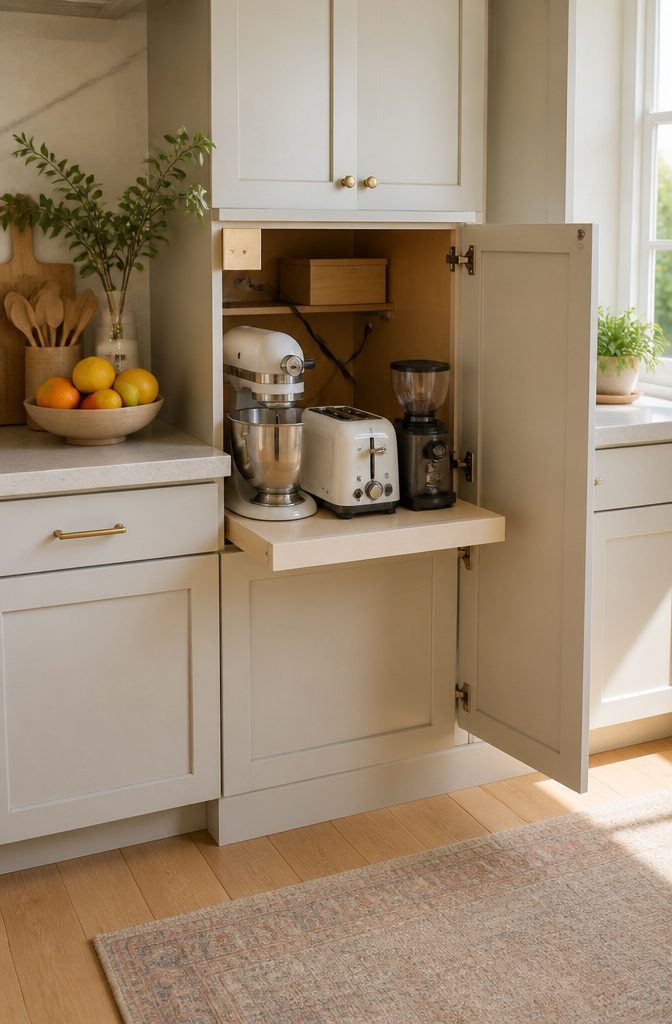
Appliance garages and lift-up cabinet doors get the Pinterest treatment, but a dedicated lower cabinet with a rollout shelf costs less and works harder. Mine sits at the end of the counter, twenty-four inches wide, housing the stand mixer, toaster, and coffee grinder on one rolling platform. Everything plugs into a single strip mounted to the cabinet wall, and I flip it on from a switch I added at the counter edge. No more unplugging three cords to use the outlet for something else.
The rat’s nest of wires that used to spill across the counter now hides inside a twelve-dollar cord-management box screwed to the back panel. The shelf rolls out far enough that lifting the mixer clear is easy; it rolls back in without fighting the cabinet frame. For renters, this beats the built-in appliance garage because you take the hardware with you and the landlord never sees a hinge.
8. Efficient Storage Solutions
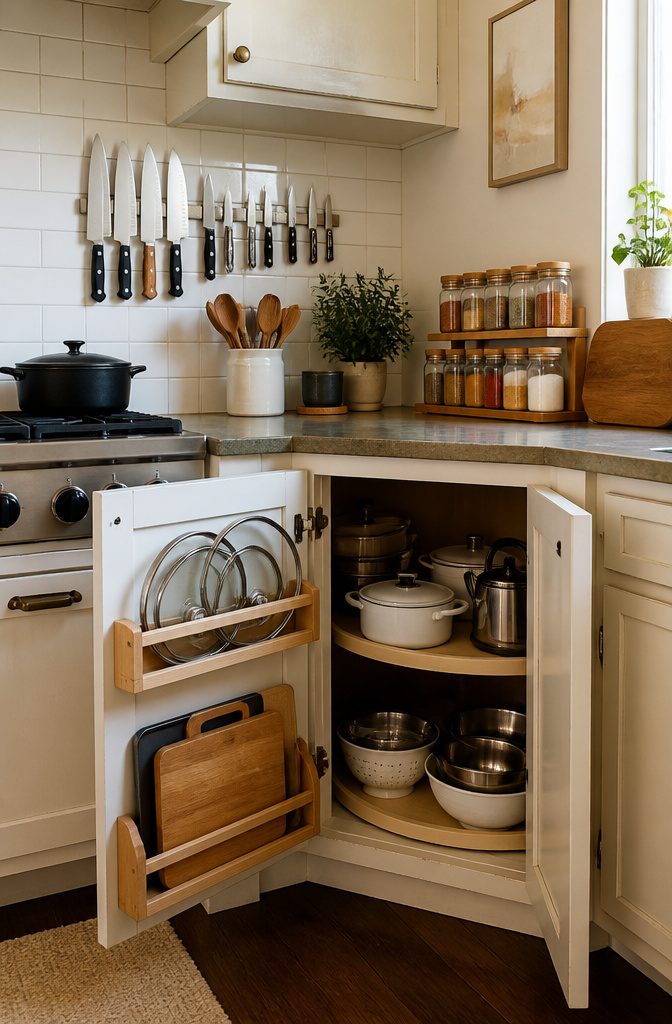
Vertical storage turned out to be the first system that actually stuck. A magnetic knife strip mounted on the backsplash freed an entire drawer for the bulky utensils that never fit in standard dividers. The knives stay dry, visible, and within reach while cooking. Door-mounted racks worked better inside cabinet doors than I expected, at least for the shallow ones holding pot lids and cutting boards stored upright. Corner cabinets stopped being dead space once a lazy Susan went in, though the half-moon shelves make more sense than a full circle in a blind corner.
The over-the-door spice rack was a different story. Every time the pantry door swung, the rack banged against the frame and jars shifted. After two weeks of adjusting it, I moved the spices to a drawer insert instead. The rack now holds lightweight backup items, sealed bags and the like, where noise and motion matter less.
What changed my thinking was realizing efficient means reachable, not packed full. A cabinet stuffed edge to edge looks organized until you need the bowl in the back. Leaving six inches of clear maneuvering space at the front of each shelf costs some capacity, but the items you actually use stop migrating to the counter.
9. Under-Cabinet Lighting
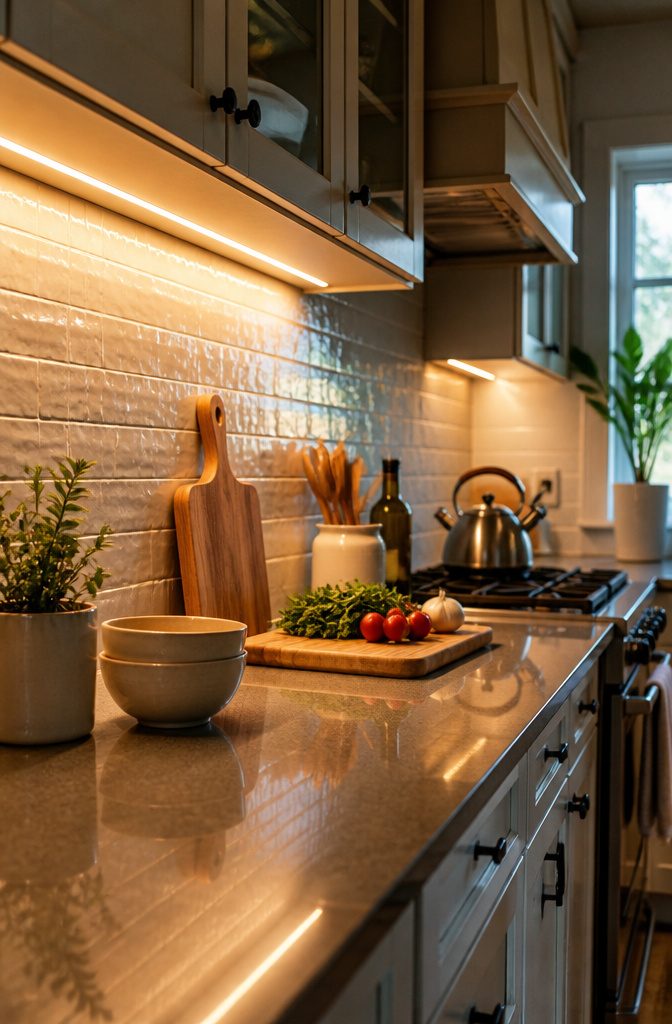
Counter space you can actually see onto makes every kitchen task faster. Under-cabinet lighting is the fix most people skip because they picture electricians and drywall dust.
LED strip lights are the cheapest way in. A $25 strip from a hardware store and a weekend of routing wire to a wall switch gave me light that turns on with the room, no remotes, no reaching under cabinets. The adhesive backing holds to the frame underneath, and the strip itself disappears behind the lip of the face frame.
Battery-powered puck lights were the wrong turn I tried first. An $8 set seemed smarter: no wiring, stick and go. Three months later they dimmed to a glow, and the replacement cycle never stopped. The hardware-store strip has outlasted two years without touching it.
Color temperature matters more than brightness. My first strip was 3000K, which threw a yellow cast that made a white countertop look like a diner booth. Switching to 4000K read as clean daylight against the backsplash and actually showed whether a tomato was ripe or just red.
10. Wood-Look Floor Tiles
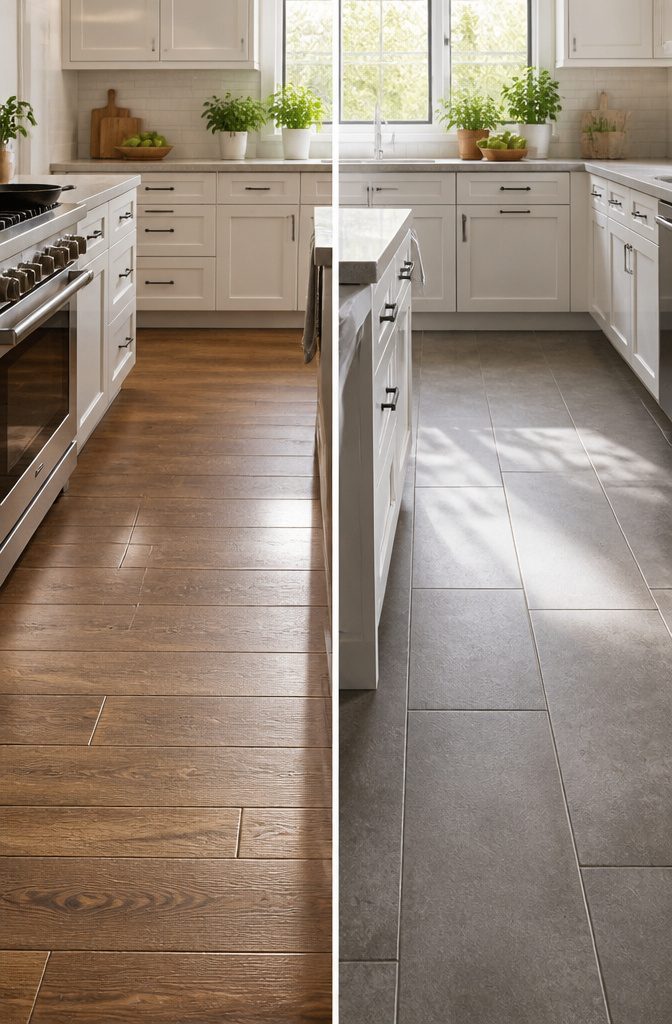
Porcelain planks that look like wood solve the real problem kitchens create for actual wood: water wins every time. A leak under the sink or a spilled pot of pasta water will warp oak before you notice the puddle. Tile does not swell, stain, or need refinishing, and a steam mop handles cleanup without worrying about moisture seeping into seams.
My mother wanted real oak until she saw the price split. The 6-by-24-inch porcelain planks we found at a discount flooring outlet ran $3.50 per square foot, against $8 for the oak she had picked out. I set them with 1/16-inch grout lines, tight enough that crumbs and grit have nowhere to hide. The narrow joints still let the floor flex slightly where the condo slab shifts, which matters more in older buildings than people expect.
She has already dropped a full cast-iron pan on it, edge-first, from counter height. No chip, no crack, just a loud noise and relief.
11. Built-In Charging Station or Tech Drawer
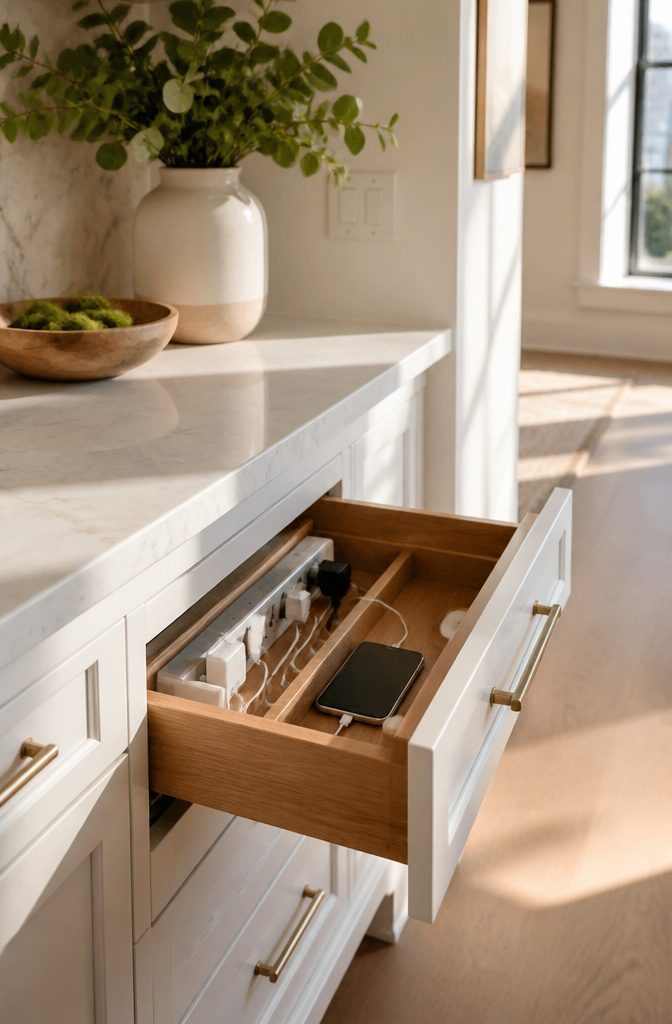
Phones and tablets left on the counter have a way of migrating toward the cutting board the second you need the space. A charging drawer solves that by keeping devices powered but out of the food zone.
The build is straightforward: a slim power strip mounts to the back panel of a drawer, with a hole drilled through the rear cabinet wall for the cord to reach the outlet. The first time I tried this, the strip sat loose on the drawer bottom. Every pull tangled the cables into a knot that took fingers and a flashlight to undo. The fix was a $6 cable organizer, the kind with channels and adhesive backing, screwed to the drawer floor so each cord has a fixed path from device to strip.
The drawer itself should be shallow. Deep drawers let devices slide and stack, which means scratched screens and missed alarms. A shallow drawer keeps everything visible and reachable.
12. Easy Kitchen Decorating Ideas
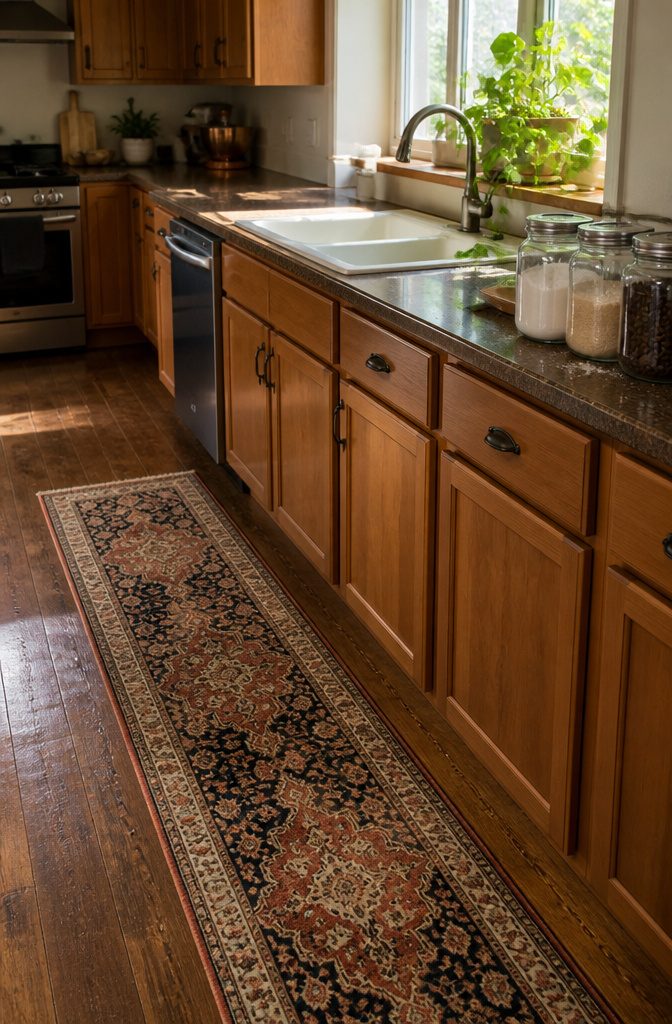
A colorful runner hides the scuff marks where kitchen chairs drag across vinyl or worn wood, and the right one costs less than a single diner breakfast. I spent $40 on a low-pile rug with a busy pattern in rust and navy, and coffee drips that would have stained a solid color simply disappear into the design. The rubber backing keeps it from sliding when the dog barrels through after a dropped carrot.
Plants that tolerate steam and shifting light matter more than the trendy ones. A $6 pothos sits on my windowsill above the sink, thriving on neglect and the humidity from boiling pasta. It droops when it needs water, which is the only kind of plant behavior I can reliably read.
Three glass jars from a thrift store hold flour, sugar, and coffee now, with metal lids that seal tight enough to keep out pantry moths. The rounded shapes look softer than the original paper bags, and the glass lets me see when flour levels drop before I start a recipe. Everything here had to survive splatter from a cast-iron skillet and a golden retriever’s tail at counter height. So far, so good.
13. Smart Kitchen Organization Ideas
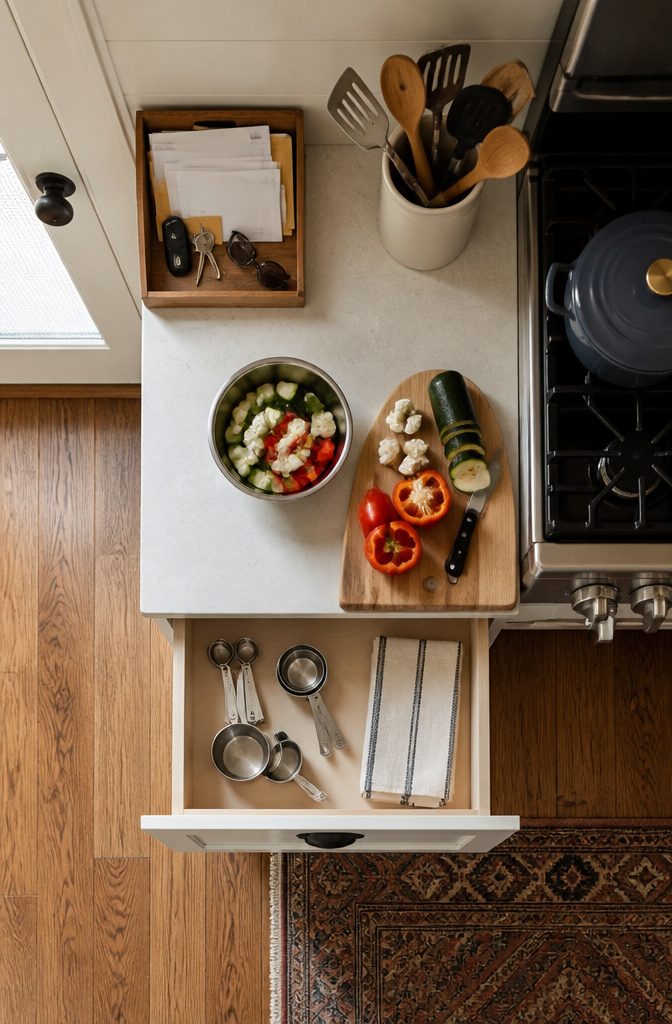
The best systems are the ones you do not have to think about. A small tray or shallow bowl by the back door catches keys, mail, and the odd receipt before they hit the counter. I started this three years ago after losing my keys inside a half-unpacked grocery bag one too many times. The bowl cost maybe eight dollars at a thrift store, and the two seconds it saves per day adds up.
Cooking by workstation changed more than I expected. Instead of grouping all spoons together, the wooden spoons live in a crock beside the stove; the measuring cups hang inside the cabinet above the baking zone. The tools stayed cleaner, and I stopped circling the kitchen mid-recipe. The one-in-one-out rule for gadgets sounds strict until you try it. A new blender means the old one goes to donation that week, not after it collects dust for six months.
What actually keeps the system alive is a ten-minute reset on Sunday evening. Counters get wiped, the bowl gets emptied, anything left on the wrong counter goes back to its zone. Miss one week and the clutter returns by Wednesday. Keep it up and Monday morning starts calmer than it has any right to.
14. Simple Cleaning Habits
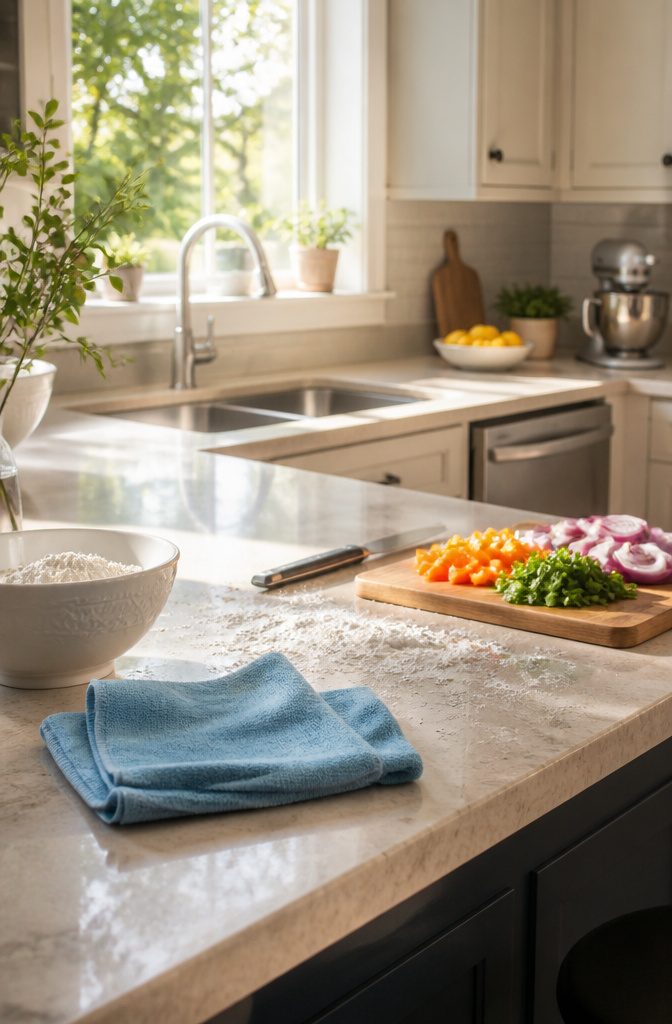
A fresh kitchen is less about Saturday deep cleans and more about habits small enough to survive a tired Tuesday. The two-minute wipe-down after cooking, while the pan is still cooling, keeps grease from setting into a project. I run a sink scrub with baking soda every evening; it takes thirty seconds and the drain stays honest. Friday evening gets a quick fridge check before the weekend starts, because one forgotten container turns into a smell that outlasts the week.
I keep a spray bottle of water and vinegar under every sink in the house. The excuse to skip it has to be better than the two steps to grab it. A microfiber cloth lives on the counter, not in a drawer, so the wipe-down happens without a search party. Dish towels go straight to the laundry at night; a damp towel left out is a smell waiting to happen. These routines fail when they feel like rules, so I built them around moments that already exist: the pan cooling, the water running for bed. The kitchen resets itself.
15. Small Kitchen Updates
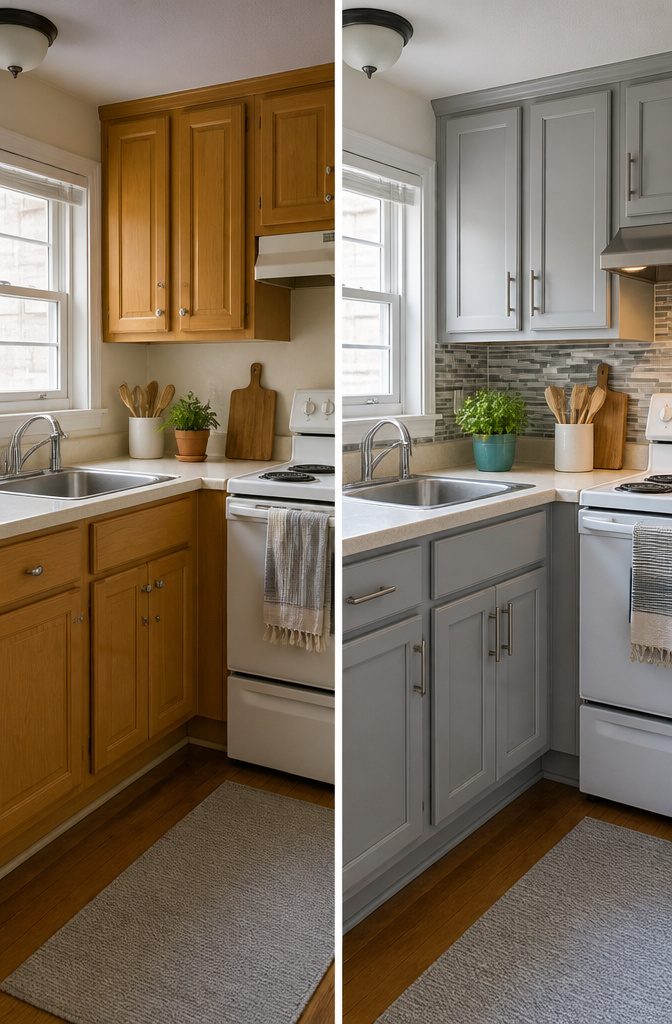
Painted cabinets, new hardware, and a peel-and-stick backsplash can remake a small kitchen for under $350 and one weekend. My own $340 run started with a quart of cabinet paint in a soft gray that covered the dated honey oak without primer. The brushed nickel pulls ran $90 for twenty-two pieces, and the $28 stick-on tile panel behind the stove went up in forty minutes with a utility knife and patience.
That tile panel has held through three years of real cooking: grease splatter, steam, and one dropped cast-iron skillet. The trick was cleaning the wall with rubbing alcohol first and pressing each seam with a grout float instead of fingertips. The pulls made the bigger visual difference than the paint, which surprised me. The old brass hardware had dated the room more than the wood tone itself.
Changed pendant lights over the sink finished the shift. A pair of $58 fixtures from a big-box store took twenty minutes to wire. The whole kitchen read as new on Monday morning, and the landlord never asked questions because nothing was structural. For renters, hardware stores return policy matters more than brand; buy one pull, test the fit, then open the rest.
What Order to Tackle These
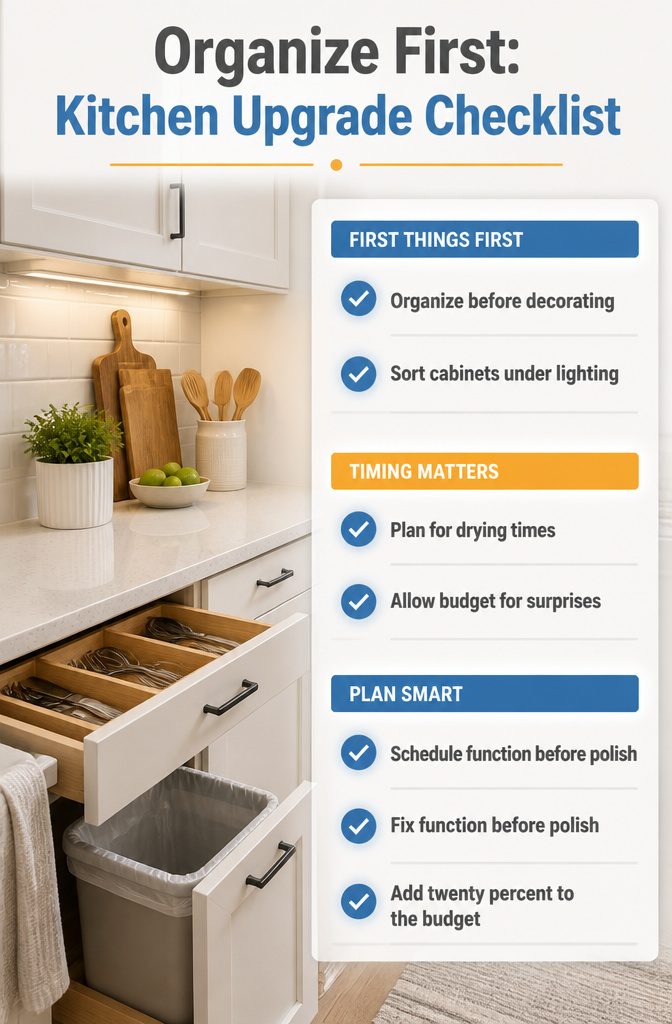
The smartest kitchen upgrades follow a simple sequence: organize before you decorate, fix function before you polish. Spending a weekend on drawer dividers and a pull-out trash bin changes how the room actually works; paint and hardware only hide clutter.
Most of these fifteen ideas pair naturally. Under-cabinet lighting goes up the same weekend you sort the cabinets beneath it. Wood-look floor tiles, though, need a full day before grout cures, so don’t schedule the baseboard repaint or appliance shuffle right after.
Whatever timeline you sketch, add twenty percent to the budget for what you find once you start. The cabinet organizer that doesn’t quite fit the corner, the junction box hidden behind old trim: these show up mid-project, not before. I learned that the hard way on my own kitchen, where a "quick" spice rack install turned into moving one outlet I hadn’t priced.
Drying and curing time is the real scheduler. Paint, caulk, adhesive, grout: each has its own clock, and rushing it means doing the work twice.
Tools I Keep Reaching For
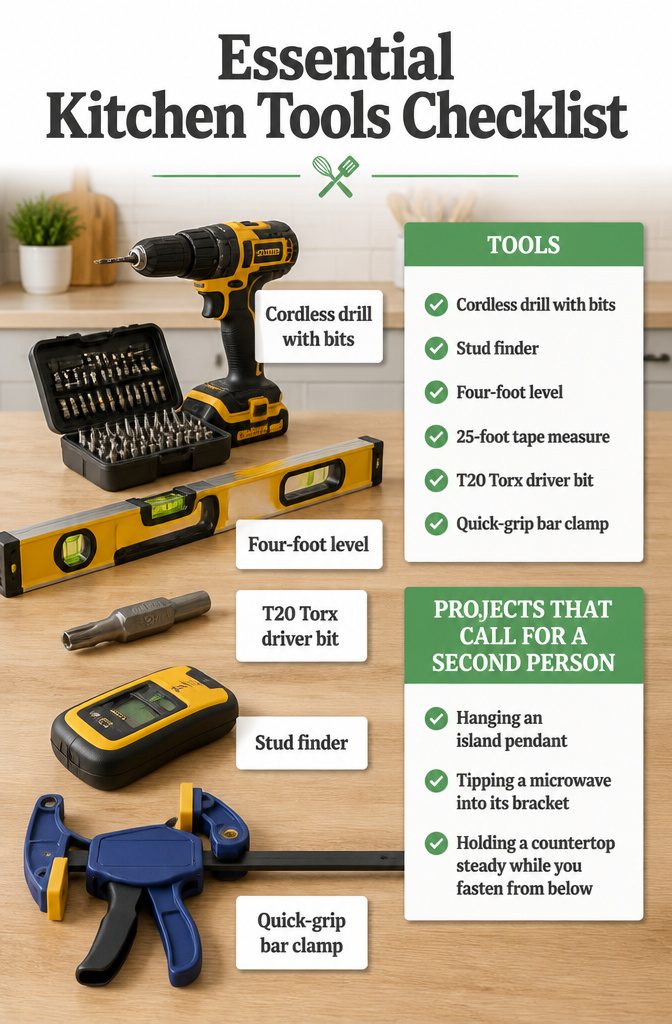
A cordless drill with a full set of bits handles most of the kitchen useful ideas in this list. The stud finder keeps shelves and rails out of drywall mud, and a four-foot level plus a 25-foot tape measure are non-negotiable for anything that spans a cabinet run. Cabinet hardware needs a T20 Torx driver bit, not Phillips, or the screw heads strip halfway through the job.
Projects that call for a second person: hanging an island pendant, tipping a microwave into its bracket, and holding a countertop steady while you fasten from below. Everything else I have done alone with a bar clamp as my extra hands. The clamp grips a shelf board to the stud while I mark holes, or holds a drawer organizer flush while I drive screws. A quick-grip style with a throat deep enough for a 1×12 board is the one that stays in my kitchen kit, not the corner of the garage.
When to Stop Adding
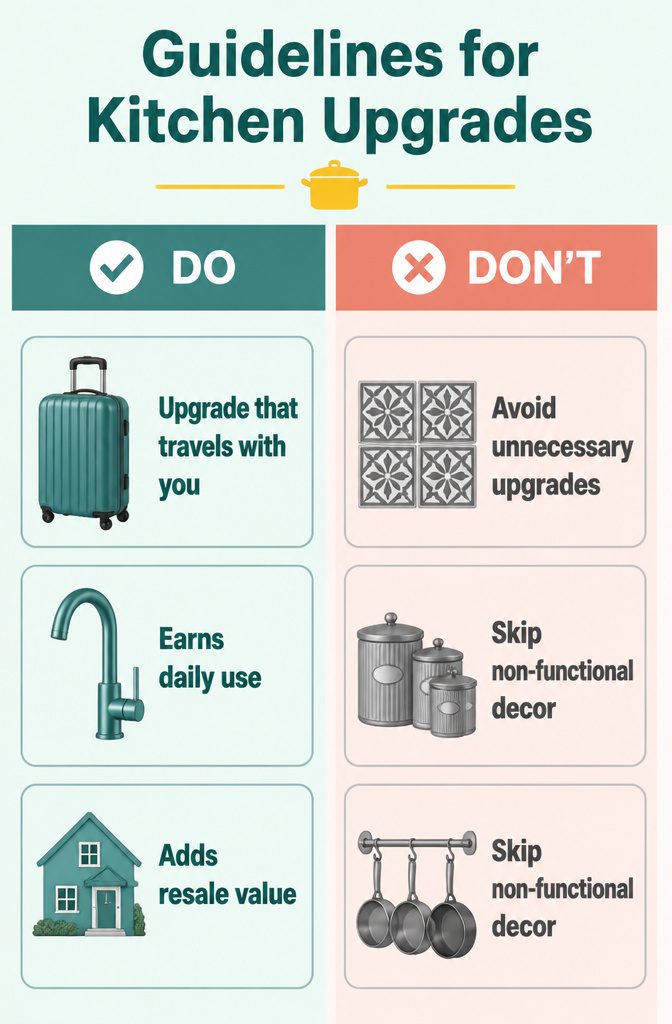
The $800 I spent on a first apartment kitchen still stings. Custom shelf liners, matching canisters, a mounted pot rack, all drilled into walls I patched myself and left behind six months later. Nothing moved with me. Nothing paid back in daily use fast enough to matter. The landlord got the upgrade; I got the lesson.
Any project now has to pass one of three gates before I touch a drill or a credit card: it travels with me, it earns its keep in daily use within a year, or it adds resale value I will actually capture as a seller. Two of the three is better. All three is rare and worth the splurge.
This gatekeeping is what keeps a list of fifteen ideas from becoming a shopping list of fifteen regrets. The pull-out trash bin that installs with cabinet screws and comes out again in ten minutes? That travels. The touchless faucet in a starter home you will sell in three years? That captures value. The custom tile backsplash in a rental with a strict lease? That fails all three, and it stays in the Pinterest draft folder where it belongs.
Frequently Asked Questions
What are some simple kitchen ideas that are beautiful, practical, and easy to do?
Start with a low-pile runner in a busy pattern to hide scuffs, a pothos plant that thrives on neglect above the sink, and thrifted glass jars for dry goods so you can see when flour runs low. A small bowl by the back door catches keys and mail before they hit the counter, and a ten-minute Sunday reset keeps counters clear. These small shifts change how the kitchen feels without a full renovation.
How can I organize my kitchen effectively?
Group tools by workstation, not by category: wooden spoons live by the stove, measuring cups hang above the baking zone. Drawer dividers cut to fit save ten minutes every time you unload dishes, and clear labeled containers stop duplicate grocery buys. The one-in-one-out rule for gadgets keeps clutter from creeping back in.