The right spice storage idea depends on your tolerance for upfront work. Tiered racks and Lazy Susans cost under $25 and take minutes to install, but matching uniform jars and decanting labels eats an evening and runs closer to $1.40 per jar. The single factor that separates the two paths is whether you own the kitchen or rent it; turntables move with you, while custom fitted racks or wall-mounted shelves only make sense when you control the walls.
Magnetic tins and cabinet-door racks exploit hidden surfaces, yet they demand steel or precise gap measurements or the door will not close flat. What trips most setups is not the organizer itself but the geometry: a 10-inch tiered rack in a cabinet with 9 inches of usable height becomes daily frustration, and a Lazy Susan that cannot complete a full rotation is worse than no organizer at all.
1. Tiered Racks
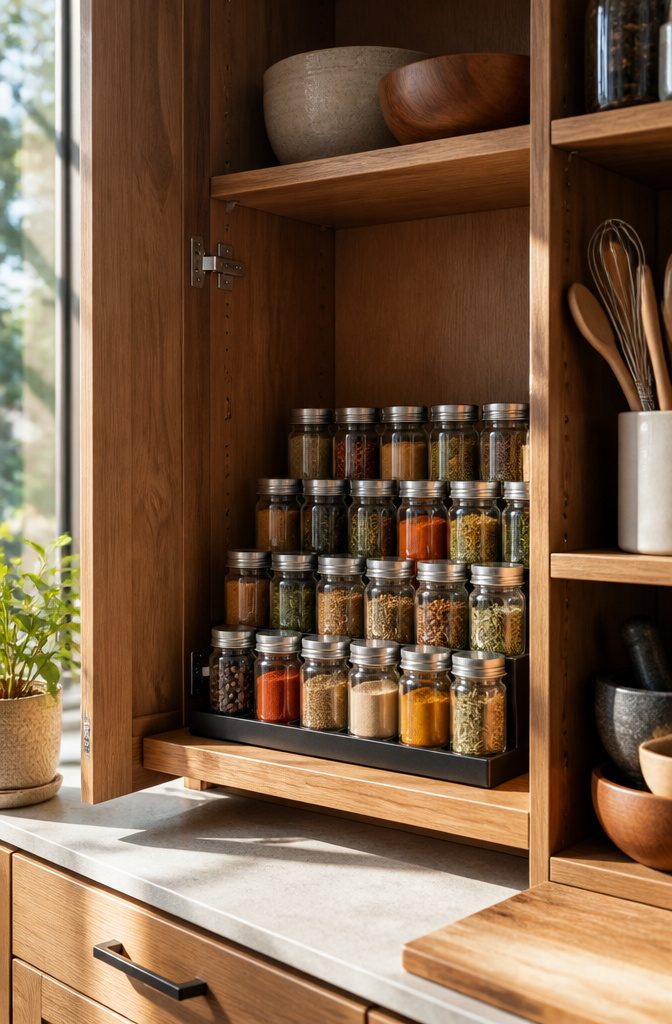
A tiered rack turns a flat cabinet shelf into a small stadium, and the back row finally gets to see the game. The stepped design lifts jars at the rear so labels stay visible without pulling every bottle forward to read it. The Container Store sells a tiered spice organizer built on this idea, and the principle is the same across most options: each row sits a little higher than the one in front, so nothing hides behind something else.
Most standard upper cabinets run about 12 inches deep inside, with shelves spaced 15 to 18 inches apart vertically. A three-tier rack usually needs 8 to 10 inches of that height to work without jamming against the shelf above, and the depth should sit comfortably inside that 12-inch box so the door still closes clean. Measure before buying, because a rack that fits the footprint but kisses the underside of the next shelf up is a rack that frustrates you every time you reach for the cumin.
The non-slip surface matters more than the material. A stepped rack with a grippy top keeps jars from sliding when you pull the one in front, and that stability is what makes the thing usable one-handed while the other hand holds a measuring spoon.
2. Magnetic Spice Racks
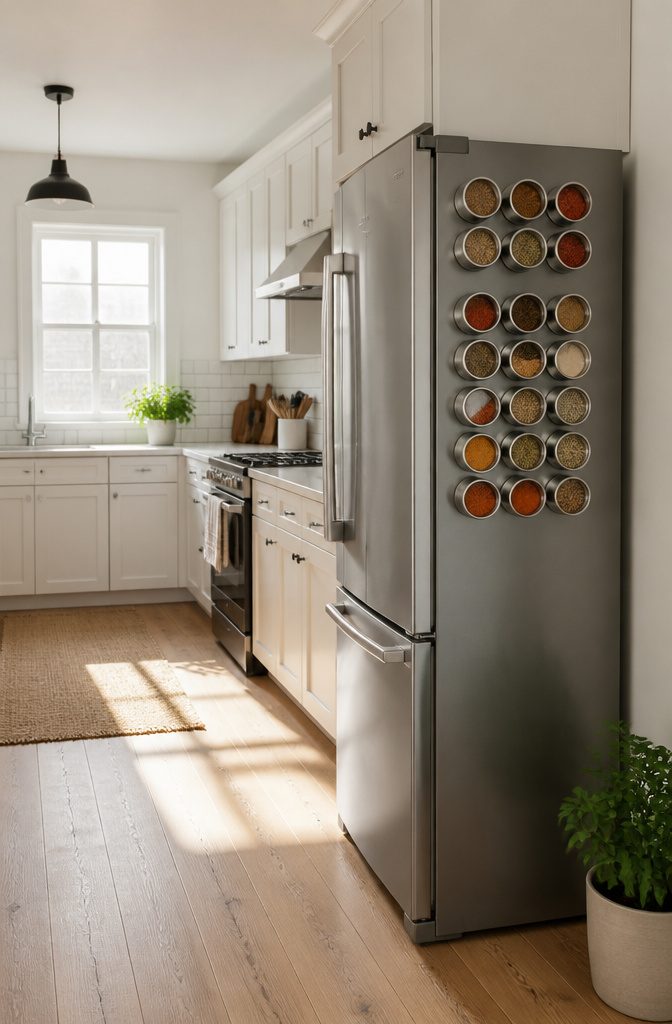
Magnetic racks turn the steel side of a refrigerator or a metal wall panel into storage that does not eat a single inch of counter or cabinet space. The rack itself mounts with no drilling in many cases, or the tins stick directly to the surface. Steel holds; aluminum or wood will not, so check with a magnet before you commit to the spot. The tins themselves are a specific product type worth hunting down: round or rectangular metal containers with a magnetic base that lets them cling in place and slide off when you need them. Most hold a few ounces comfortably before gravity wins and they start to drift downward, which means the heaviest-use spices, or at least the fullest tins, belong on the lowest row. One honest limit here is the setup. Decanting spices from their original jars into these tins takes an evening, and you may end up with surplus that still needs a home. I like the look enough to find that tolerable; someone who wants instant results might not.
3. Lazy Susans
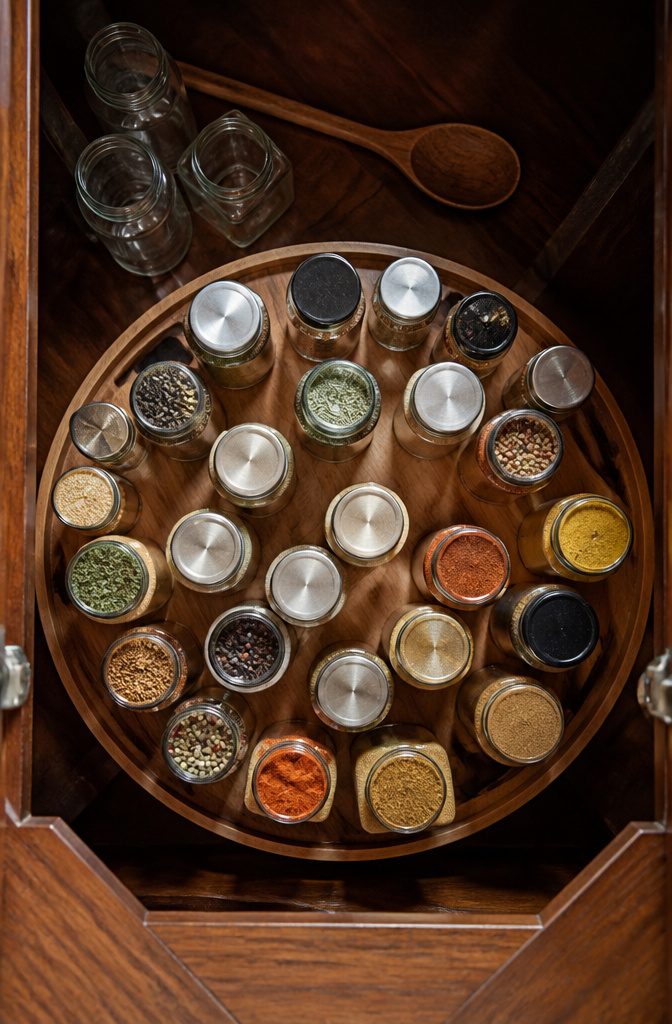
A rotating platform turns a blind corner cabinet from a black hole into something you can actually use. The spin brings the back row forward, so a bottle buried twelve inches deep takes one flick of the wrist to reach. Most basic models run under $25, which is low enough to test before committing to a bigger system.
The turntable wins in two situations: deep corners where you would otherwise lose items to the shadows, and upper cabinets where you cannot see the back row without a step stool. In both spots, the rotation replaces digging and re-stacking with a simple turn.
It fails on narrow shelves. If the platform cannot complete a full rotation without hitting the cabinet wall or the neighboring stack of plates, it becomes more obstacle than aid. Measure the depth and width before buying, and skip it if the clearance is tight. Taller cabinets present the same problem in the vertical direction: one tier of bottles leaves a lot of empty air above it, and a double-decker Lazy Susan costs more than the entry-level price that makes these tempting.
4. Drawer Organizers
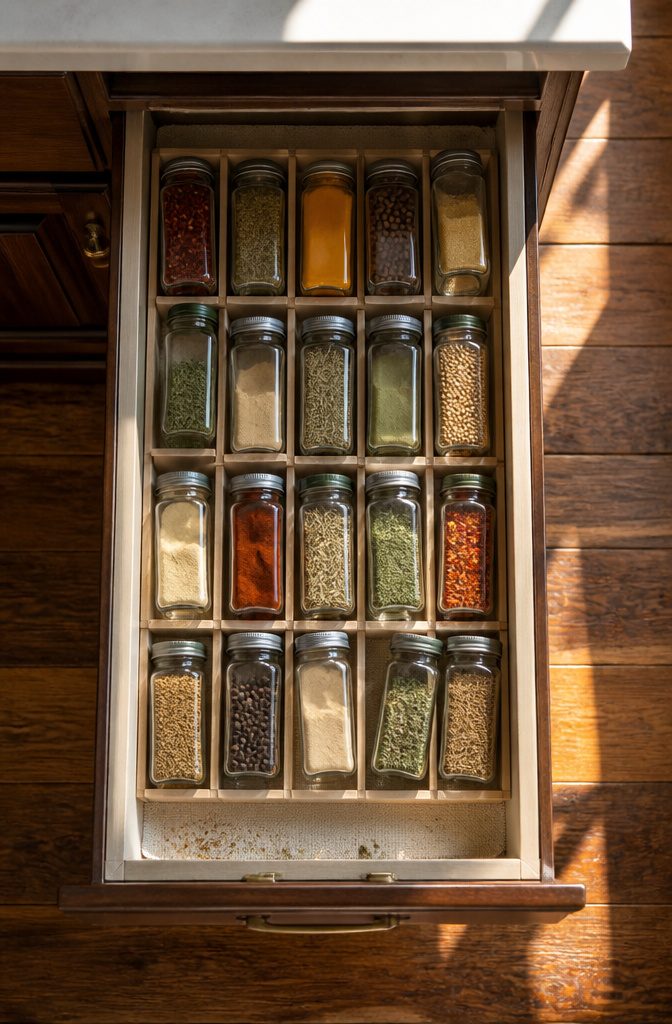
A drawer organizer stops spice jars from rolling into a jumble every time you pull it open. Most standard kitchen drawers run 15 to 24 inches wide and 18 to 21 inches deep, which gives enough room for either a standing or flat arrangement depending on what you have.
Standing bottles work best in a deeper drawer. A divider or expandable rack keeps them lined up alphabetically or by category, labels facing forward so you can grab what you need without unstacking anything. The YouCopia 10-inch drawer organizer and similar expandable racks angle jars slightly upward, which keeps them visible and prevents tipping.
Flat arrangements suit shallow drawers better. Laying jars on their sides with labels facing out lets you see exactly what you have left, and a fitted inlay or rounded insert holds each bottle snugly so nothing shifts. Shallow drawers win here because you are not reaching past layers to find the cumin buried at the back.
An adjustable insert like the Expand-A-Drawer, priced under $20 at The Container Store, spans a range of widths for a custom fit and protects the drawer bottom from spills. If the organizer leaves a gap in a wider drawer, that extra space works for foil, plastic wrap, or backup jars.
5. Clear Storage Bins
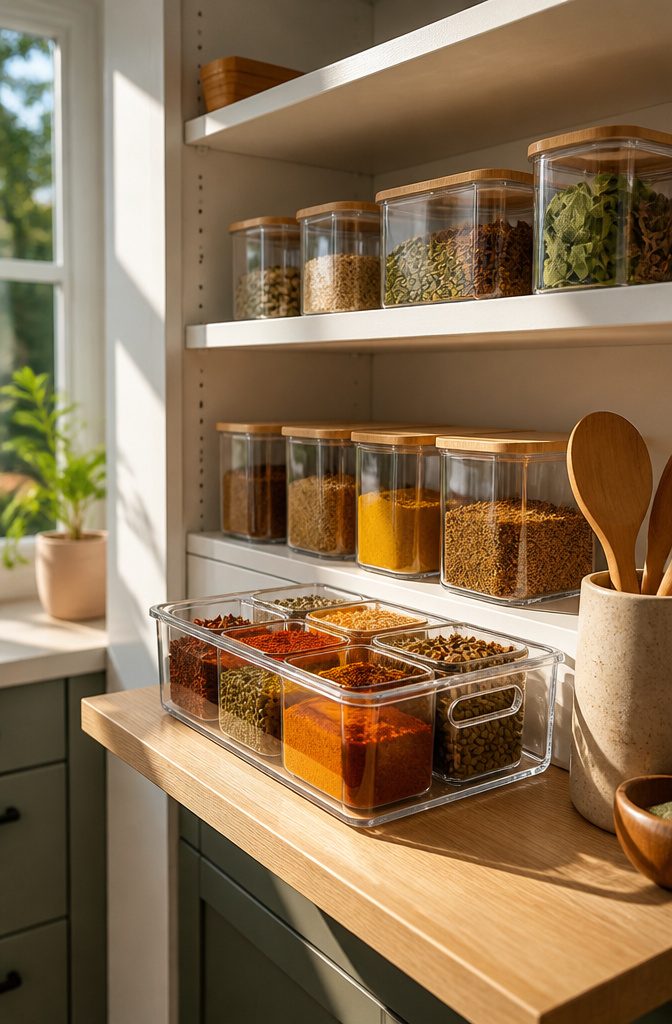
Clear bins turn a deep cabinet from a black hole into something you can actually use. A 10- to 12-inch long bin fits standard upper-cabinet depths without catching on the door hinge, and the width depends on your shelf: two 6-inch bins side by side, or one wide bin if you cook in batches and need everything at once.
Sterilite makes lidded versions that run about a dollar at Target, though any see-through plastic works. The trick is grouping by how you actually cook. One bin holds the daily drivers: garlic powder, cumin, whatever gets grabbed three times a week. Another sits further back with the single-use players like ground cloves that come out twice a year. Pull the whole bin out, use it, slide it back. No more kneeling to read labels on jars lined up in a row you can’t reach.
The downside is exactly that lid. For spices you use constantly, stopping to open and close a container gets old fast. These bins earn their keep on the second string: the keep-on-hand-but-out-of-way collection that would otherwise rattle loose or migrate to the back and expire. Stack them in a pantry if cabinet space is tight; the vertical footprint stays small and you still see what you have.
6. Wall-Mounted Shelves
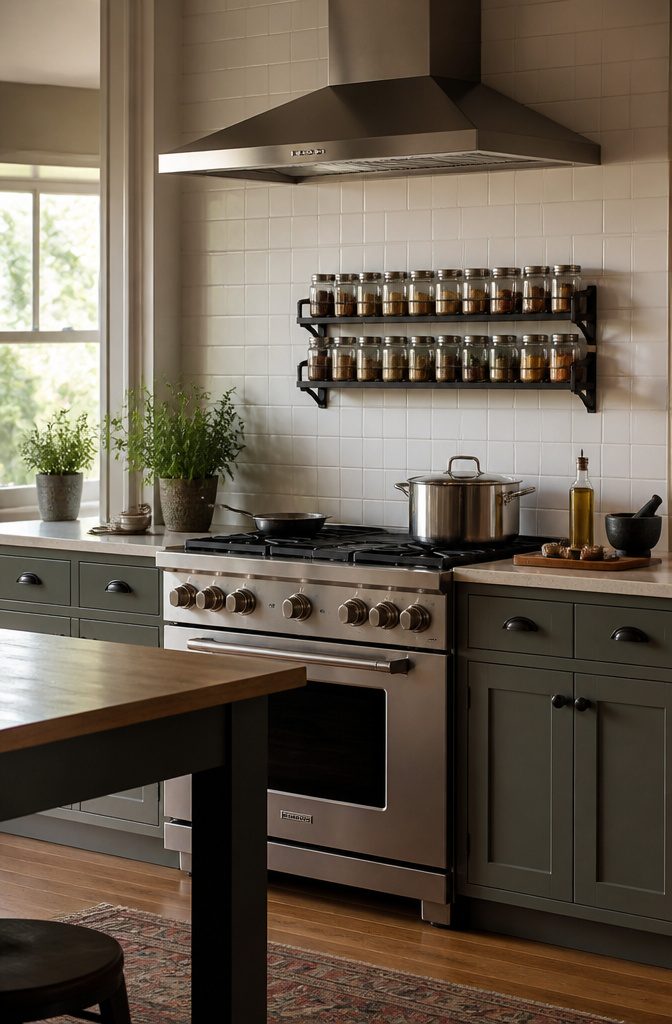
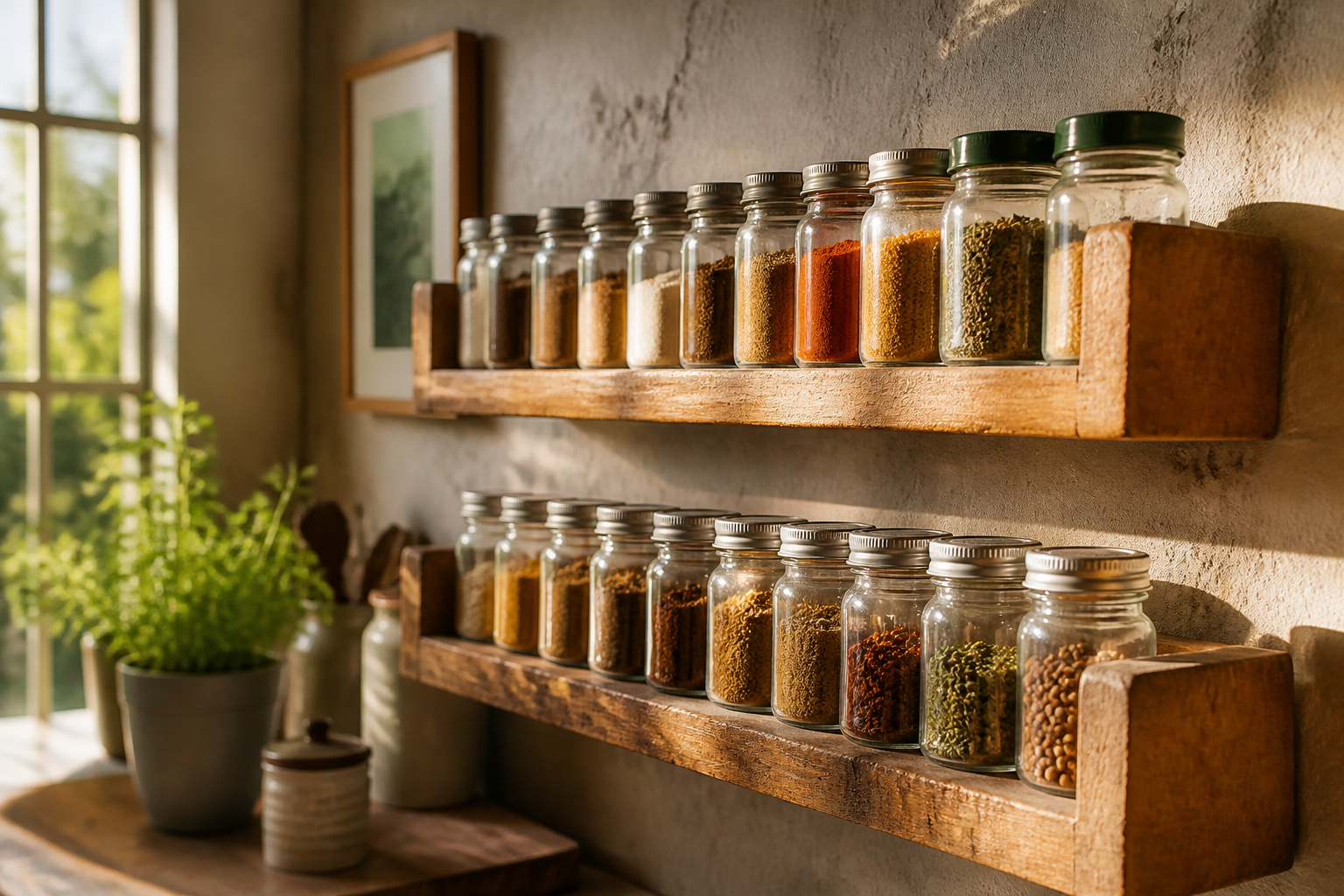
Wall-mounted shelves free up the counter for actual cooking and keep the jar you need within arm’s reach of the burner. Three to four inches of depth is all the shelf needs; anything deeper wastes space and collects dust behind the jars.
What the wall is made of decides how the shelf goes up. Studs are ideal. Drywall anchors work where studs miss the mark. Tile demands a masonry bit and patience; chip one piece and the whole backsplash looks wrong.
Open shelving beside a stove carries a cost the photos never show. Grease rides the air in a thin film, settles on jar labels, and soaks in. Paper labels soften and smudge; printed names fade to guesses. The fix is either sealed labels or accepting that the front row will need a wipe-down twice a year. Grease absorption is the trade you make for grab-and-go access.
7. Custom Spice Organizers
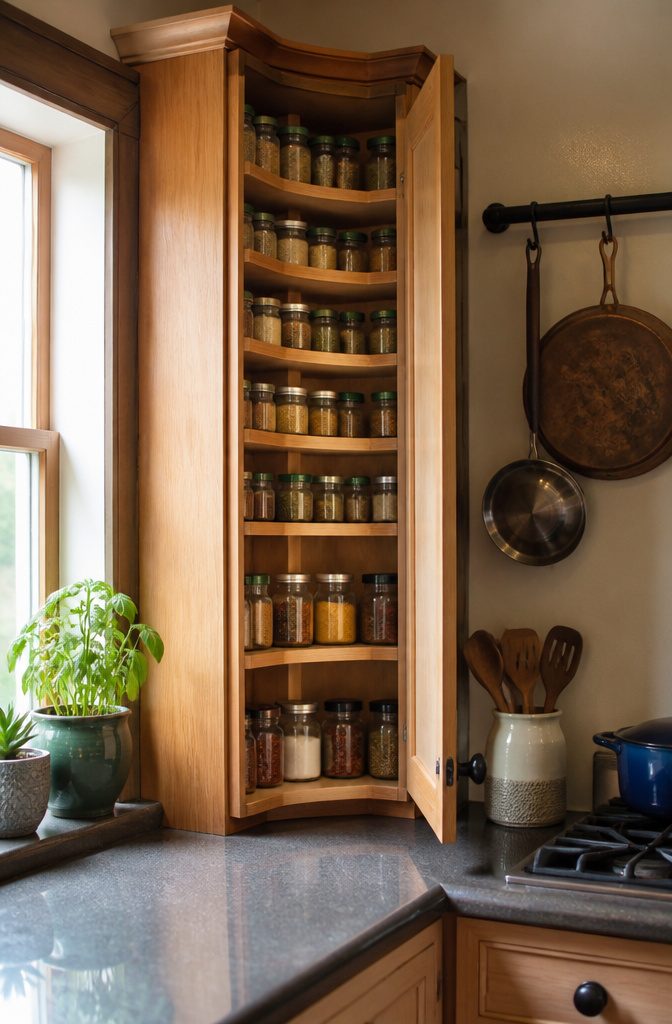
Custom spice organizers fill the gap when standard sizes leave you staring at an angled ceiling or a cabinet that predates modern kitchen standards. Cut-to-fit drawer inserts and cabinet-door mounted racks can be ordered to exact dimensions, which matters more than most people realize until they try to wedge a 12-inch pullout into an 11.5-inch opening.
The investment pays off in two situations: irregular cabinet layouts where nothing mass-produced will sit flat, and tall drawers that can be fitted with peg-adjustable shelves sized to the jars you actually buy. A Rev-A-Shelf pullout with adjustable pegs lets you remove a shelf entirely for bulk containers, something fixed-tier units simply do not accommodate.
For standard base cabinets with right angles and conventional depths, off-the-shelf options usually suffice. The difference between custom and ready-made is less about looks and more about using the last two inches of depth that a universal size forfeits. Measure twice, and if the gap between your cabinet wall and a stock unit is more than a finger’s width, that is when the upgrade starts to make sense.
8. Uniform Jars
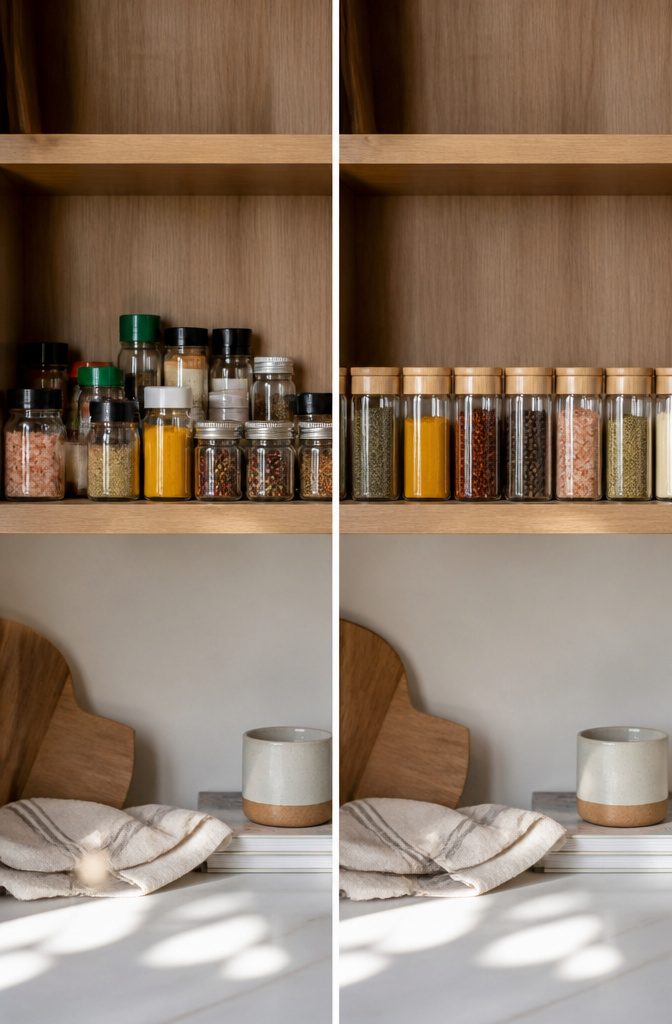
A row of mismatched spice bottles on a shelf reads as clutter even when the space is technically tidy. Decanting everything into uniform jars fixes that instantly, and the tight seal on a matching set keeps spices fresh far longer than the flimsy lids they arrive in.
The 3 oz. glass spice jars with bamboo lids hit a useful sweet spot: big enough for a bulk bag refill, small enough to line up without wasted space. Sets of 24 or 36 often run under $1.40 per jar, which puts the whole swap within reach of a modest project budget.
The labor is real. Transferring, wiping rims, and labeling two dozen jars eats an evening. For the cumin you reach for twice a week, that time pays off in daily visual calm and a lid that actually closes. That packet of marash pepper you bought once for a single recipe, though? Leave it in the pantry in its original bag. The uniform look only matters for what you actually see.
9. Labels
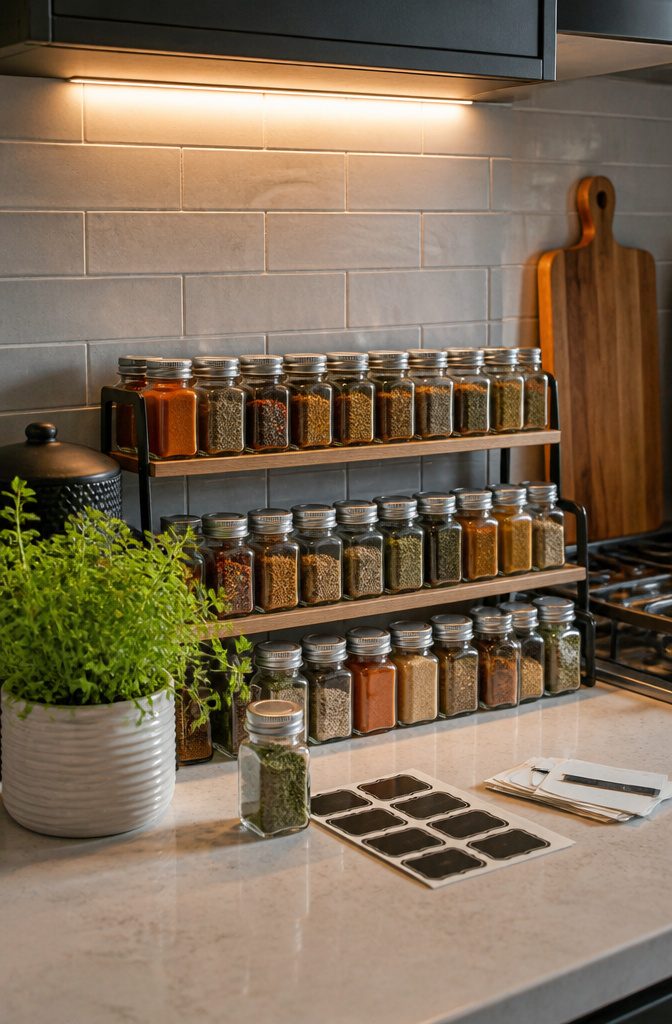
Once every spice has been decanted into matching jars, the labels are the only thing standing between you and a pan of cumin-scented oatmeal. A Brother P-Touch label maker, around $29, prints clean thermal text with a QWERTY keyboard and stores up to fifteen labels for reprints. That uniform look matters when jars sit out on a counter or open shelf.
For a test run, masking tape and a permanent marker work fine. Live with the arrangement for a week before committing to printed labels, since the position changes what you read. Top labels on lids suit drawer storage where you look straight down; side labels face forward on shelves or tiered racks. One stackable set from Good Housekeeping includes 386 black labels and a white chalk marker with its 28 glass jars, enough to relabel as tastes shift.
With four tiers in total, this stackable spice shelf set includes 28 clear glass jars—plus 386 black labels and a white chalk marker so you can label each one.
That volume of blanks matters more than it sounds: you will add spices you did not plan for, and peel-and-relabel beats a crossed-out jar every time.
Declutter First
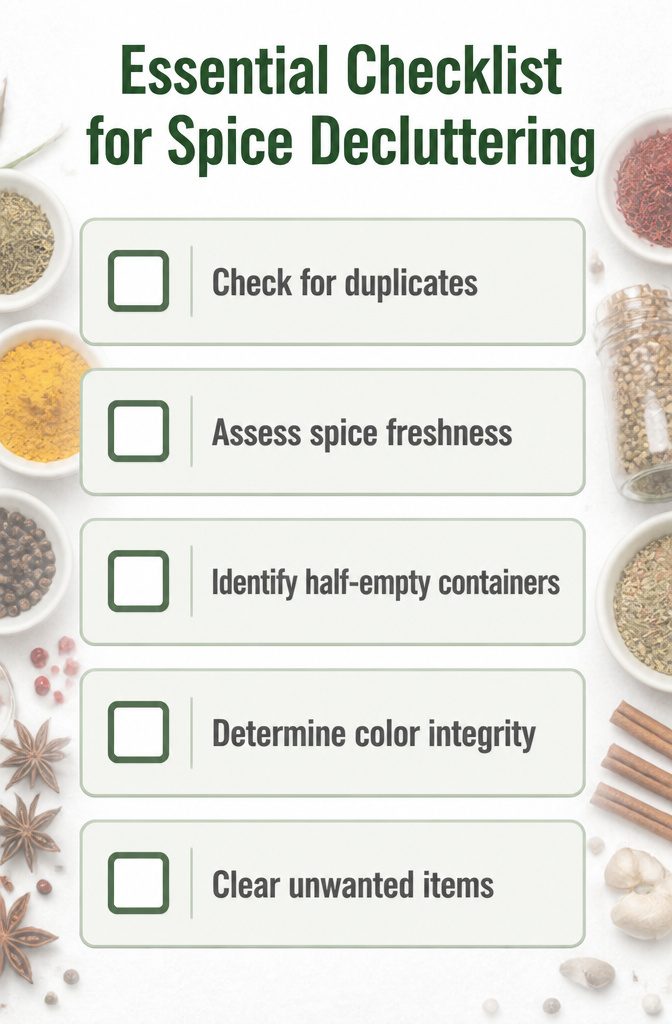
Pulling every jar and packet out at once turns up the duplicates hiding behind the turmeric and that cumin bought twice because the first bag slid behind the flour. Half-empty doubles waste more cabinet real estate than the spice itself, so matching like with like comes before any rack or bin gets chosen. The test for what stays is simple: color should still look like the plant it came from, the powder should shake loose without clumping, and the smell should hit you when you crack the lid. Fading, caking, or a faint whiff that barely registers means the jar is taking up space a fresh bottle could use. What convinced me, reading through how organizers actually work, is that the guilt over a 1995 jar is universal and useless. Bin it and move on.
Cooking Zone Placement
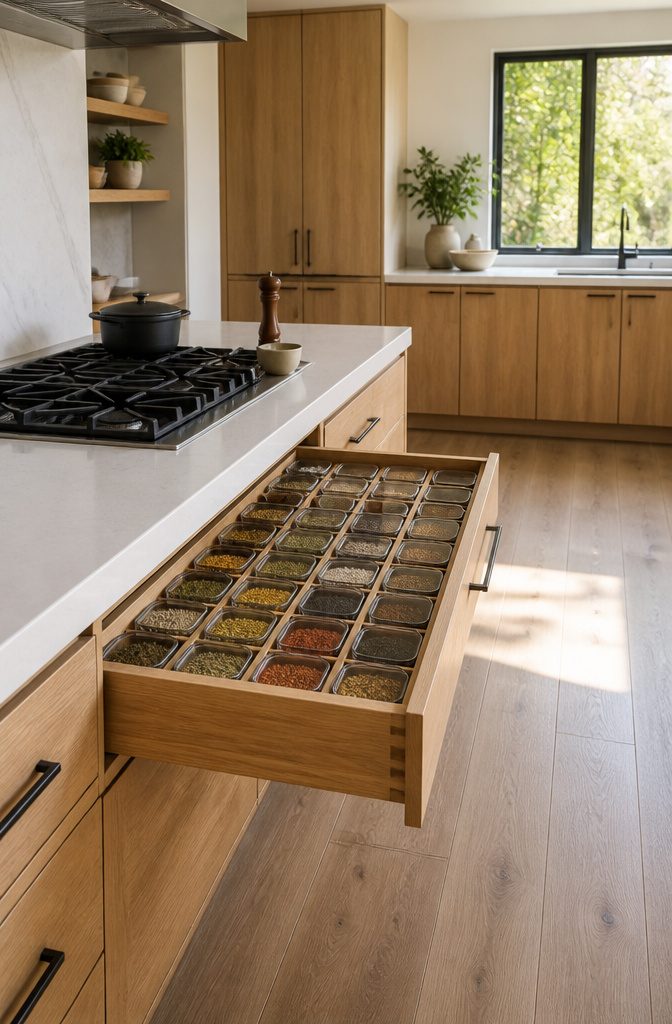
The best spice storage ideas start with keeping what you cook with closest to where the cooking happens. Herbs and spices belong near the stove and prep areas, not across the kitchen in a pantry or tucked into a distant cabinet. That proximity cuts down on steps during active cooking and lowers the risk of cross-contamination, especially when you’re handling raw meat or fish and reaching for seasonings with the same hands.
Placement dictates shape. A drawer beside the range works well for flat labels facing up, while a narrow counter strip suits a lazy susan or small tray for oil, salt, and pepper. Wall-mounted racks or upright cabinet organizers need vertical space within arm’s reach of the cooktop.
There are sensible exceptions. Baking spices stored near the stand mixer keep flour-dusted hands away from the savory zone. Grill spices by the patio door eliminate back-and-forth trips with raw proteins. The principle is zone-based, not stove-obsessed.
Surplus jars and backup supplies should live in the pantry or a deep cabinet. Opening a secondary jar before the main one is empty exposes both to air and shortens freshness faster than finishing one first.
Budget-Friendly Options
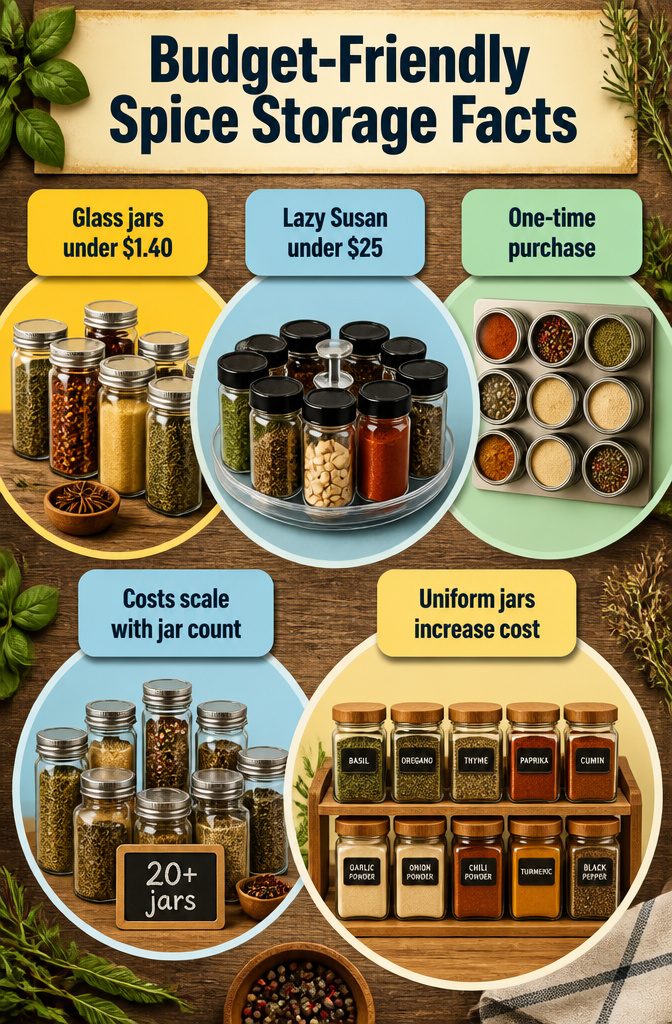
Most spice storage ideas cost less than people expect. Glass spice jars run under $1.40 each, and a single Lazy Susan-style turntable lands under $25, sometimes closer to $10 if you catch the right size. The spending that scales is the jar count: twenty spices means twenty containers, plus labels, plus maybe a funnel for refills. One turntable does not scale. One set of magnetic tins does not scale. You buy it once and the cost stays flat.
A basic tiered rack or a simple metal frame that sits on a shelf works the same way. The price is the price, and the only variable is whether your cabinet is deep enough to hold it. What does add up is the moment you decide every jar must match and every label must be waterproof. That kit looks intentional fast, but the price moves with every piece you add.
My own leaning is toward the turntable for renters. It rotates out with you, and a non-skid surface keeps jars steady even when the cabinet is half-empty. If you own the place and know your spice count, uniform jars on a stepped rack make more sense. The cost difference between those two paths is usually the cost of the jars themselves.
DIY Builds and Repurposed Materials
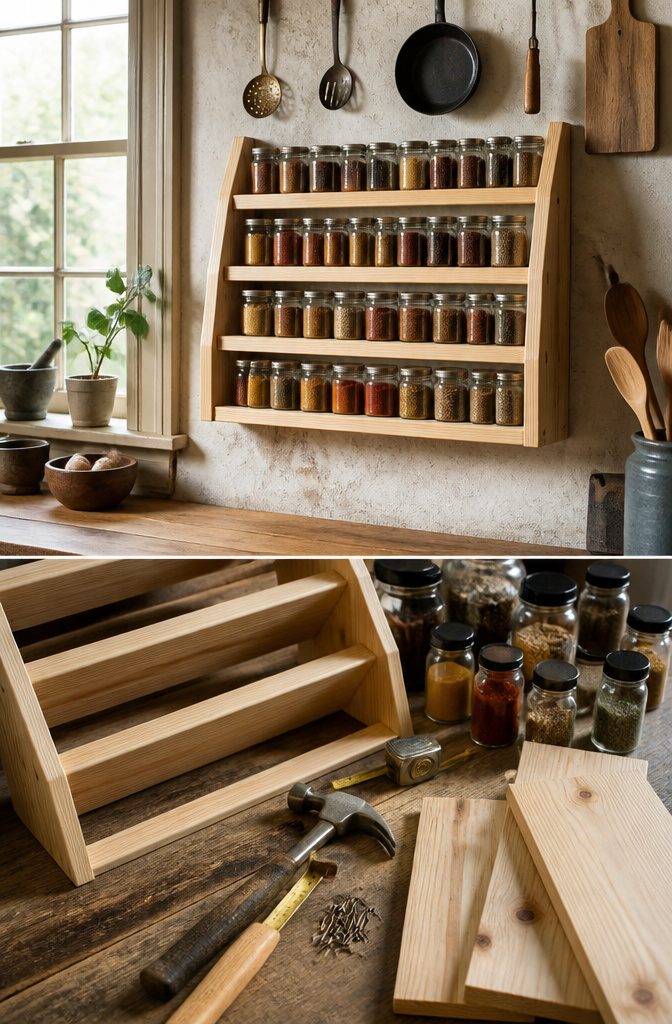
Some spice storage ideas only make sense if you already own the tools and the scrap wood. A tiered rack built from leftover plywood or pine boards costs almost nothing in materials, but the geometry matters more than the build itself. Each tier needs enough depth that labels face forward, not up toward the cabinet shelf above, or you will still be lifting jars to read them. That is the mistake that turns a Saturday project into a Sunday redo.
Repurposed materials sit in a different category. Vintage lab equipment like test tube racks with stoppers mount flat against a wall and hold spices in glass tubes that read as decor. The look is specific, almost apothecary, and it works best when you buy spices in bulk to fill the narrow tubes rather than trying to decant from standard jars.
The build-versus-buy decision usually breaks on time, not material cost. A geometric scrap-wood rack can run under ten dollars in lumber but eat a full weekend in measuring, cutting, and finishing. Store-bought tiered racks start around fifteen dollars and take twenty minutes to place. The DIY route wins when you want a custom depth or counter height, or when the scrap is already in your garage. Otherwise, the store-bought version is the cheaper project.
Non-Traditional Spaces
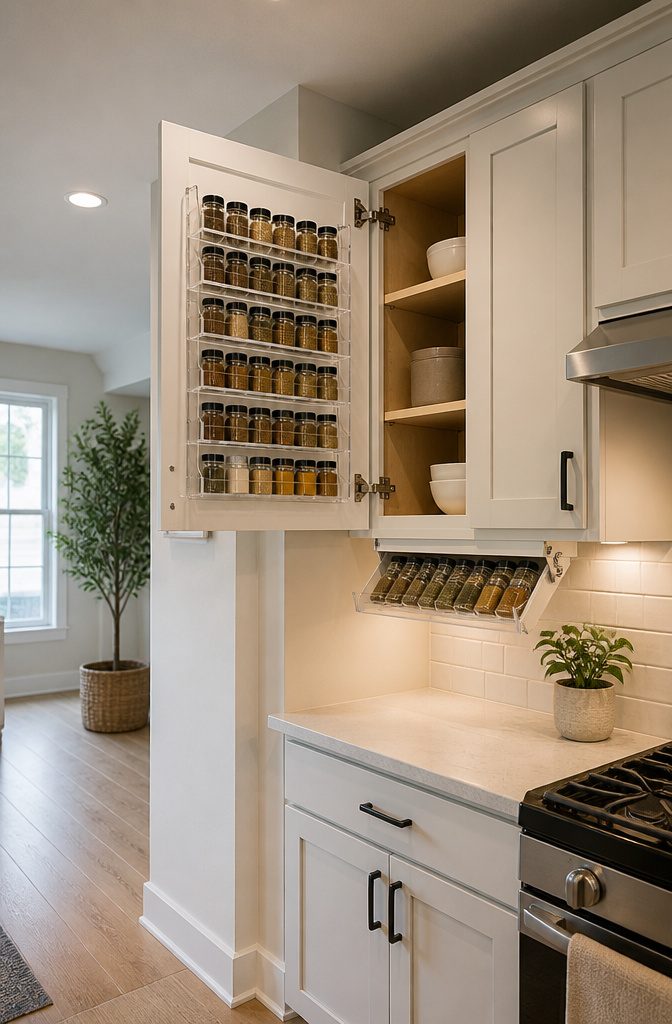
The inside of a cabinet door is wasted real estate until you mount a shallow rack there. An acrylic shelf maybe an inch deep holds standard jars without stealing shelf space, and the hardware usually needs just two screws. What convinced me, reading through the setups that actually work, is that you need clearance: the door must still close flat, so measure the gap between the closed door and your shelf fronts before you buy anything. In a small rental kitchen, that same logic pushes spices under the wall cabinets on flip-down holders. You reach up instead of bending, which tall cooks notice immediately, and the jars stay off the counter and out of the cabinet entirely. The narrow gap beside a stove or fridge takes a slide-out rack instead, the kind that glides out and locks. These spots read as dead space until you live with one pulled out mid-recipe and realize the whole row was hiding in six inches of shadow.
Frequently Asked Questions
How do you organize spices in a drawer?
Stand jars upright with labels on the lids, or lay them flat with labels facing out, using an expandable or angled organizer to stop them from rolling. A deeper drawer suits standing bottles; a shallow one works better for flat arrangements. The YouCopia 10-inch organizer and similar racks angle jars upward for visibility, while an adjustable insert like the Expand-A-Drawer under $20 at The Container Store gives a custom fit and protects against spills.
What are some creative ways to store spices?
Tiered racks inside cabinets, magnetic tins on a refrigerator side, and Lazy Susans in deep corners all reclaim wasted space. Wall-mounted shelves beside the stove keep seasonings within arm’s reach, and shallow racks screwed inside cabinet doors turn dead air into usable inches. For irregular spaces, custom cut-to-fit inserts use the last two inches a stock unit would forfeit.
How can I label my spice jars?
Put top labels on lids for drawer storage where you look straight down; side labels face forward on shelves or tiered racks. A Brother P-Touch label maker around $29 prints clean thermal text and stores up to fifteen labels for reprints. Masking tape and a permanent marker work fine for a test run before committing, since the position changes what you read. One stackable jar set includes 386 black labels and a white chalk marker, enough to relabel as tastes shift.